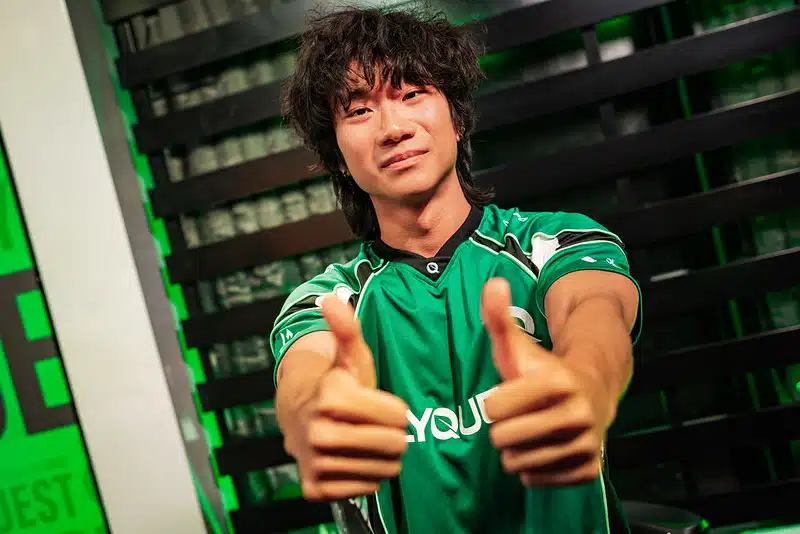
FlyQuest jungler Johnson “Griffynn” Le moved to Korea at 16 years old to try and climb up the region’s brutal League of Legends player development system.
It was uncomfortable, especially since – by his estimation – he probably could have been in the LCS by then. But the lure of playing in the hotbed of the game in one of the most prestigious academies in the world (T1 – home of Faker) as one of the first foreigners in the academy was too much to pass up.
“It just seemed like at the time … it was a no-brainer,” he said to Esports Insider.
- “It’s important to foster the grassroots nature of TCGs”: T1 CEO Joe Marsh talks entering Riftbound, T1 bundle cards, and grassroots communities
- VALORANT Game Changers is struggling and Riot Games is the one that needs to save it
- Even the Dota 2 pros are bored with Tier 1 tournaments: Let’s shake it up with Fearless Draft and Tier 2 teams
But while he valued his time in Korea, it wasn’t until he went to Brazil that he saw his gameplay take major steps forward.
“I made a lot more progress when I made it to Tier 1,” Griffynn said. “By playing scrims against Tier 1 players, having a good [Tier 1] coaching staff … actually did help me more than being in Korea for an extended period of time.”
So what did Brazil – a region still considered lower-tier globally – give him that Korea’s faster internet and tougher solo queue didn’t?
“Coordinated practice will matter most,” Griffynn said.
But are there enough in place to make that happen in North America?
Three paths, no map

At 16, Griffynn chose to leave the country to become a better League of Legends player – joining a generational organization and training amongst the best in Korea.
Testing his skills was one thing. What he actually needed was regular reps against Tier 1 players at Tier 1 speed – and Brazil, with LOUD, gave him exactly that.
“CBLoL was an amazing experience,” he said. “I joined LOUD, probably the best organization to join in CBLoL, and they treated me really good, the fans were amazing, it was great.”
While Griffynn could be seen as a special case, Dignitas general manager Jonathon McDaniel said the departure of the West to train in Europe or Asia is one of three pathways’ players can take when trying to go pro.
The first one is the traditional Tier 2 route, where teams play in the North American Challengers League. The second is going to college and playing esports, while the third locks players into joining an academy abroad.
The issue, however, was the tree’s most well-known branches (Tier 2 -NACL vs. Collegiate Esports) have offered more confusion than clear answers.
“They’ve kind of converged into a bit of a soup where a lot of the teams that are formed in tier two over the last few years have been either an entire collegiate roster or like bits and pieces of a collegiate roster with one or two ringers on the side,” McDaniel said to ESI.
The blurring of lines has SIDO CEO and founder Parth Naidu bluntly stating that he has a “short list” of things he likes about the NACL.
“NACL has nothing to do with player growth,” Naidu said. “I like that [NACL] exists, I guess there’s that. NACL hasn’t quite decided on what they’re going to be and how they’re going to cater to players and teams, right?”

NRG coach and former Evil Geniuses coach Razvan Nistor also added that the cultural gap isn’t about merely Korea’s gaming-friendly culture and larger player base.
Instead, he locked in on how players are learning skills – and mastering them.
Korean players will become masters of mechanics, coordination, and game planning by blunt force hours invested. They will grind for hours for days, learning through experience and endless repetition of situations.
North America isn’t going to push that 11-hour grinding mentality because the player base isn’t deep with quality players or issues in connectivity.
Instead, Nistor believes that the training focus should be on quality and with focused instruction.
“I was showing [LCS professional Impact] my framework on how to develop teamfight understanding,” Nistor said. “There are steps that you need them to go through. You can explain a certain amount of the concept, make them do a couple of baby steps, fall over, but explain the steps rather than giving them the conclusion.
“Before you do a pull-up, you should be able to hang on the bar.”
SIDO and NRG, who play in the NACL, partnered to develop a framework for player development.
“We wanted to take a more hands-on approach, so we have an exclusive partnership,” Naidu said. “For the next few years, [we] want to basically build out their performance side.”
But that’s the only thing that Naidu hopes to fix with SIDO.
Building the fix for NA
Naidu witnessed firsthand the shortcomings of North America’s talent development. He spent seven years working with Team SoloMid, affectionally known as TSM, as both a coach and a general manager of the now-defunct, but forever loved League of Legends team.
He founded SIDO in 2022, hoping to improve player performance and build individual skills that would eventually help players rise to the top and strengthen the region’s esports rosters.
Every year, SIDO hosts the SIDO Boot Camp where high ELO players are invited to develop their individual skills with position coaches and coordinated practice opportunities for players to learn the finer art of playing with four teammates.
Nistor’s staff includes Ian “Ido” McCormmick and Mervin-Angelo “Dayos” Lachica, among others.
“We’re doing that through SIDO,” Nistor said. “All the players that get Challenger and join our combine, right, they get access to good coaching. I would say it’s good coaching in my opinion, be it from me, be it from Ido, be it from Dayos, or like all the other guys that assisted.”
The boot camp has few alumni who are rookies in the LCS – Michael “Cryogen” Luu, Sajed “sajed” Ziade, Christian “KryRa” Rahaian, Isaac “Darkwings” Chou to name a few.
It isn’t just a boot camp in the United States; SIDO also plans on bringing players to Korea to get both types of practice – the grindy quality of the Korean server and the coordinated efforts of playing against the teams there.
This offers players a chance to work along with positional coaches, while also coordinating practice and connection with LCS teams.
“I just want good players who have had a lot of team environment experience,” McDaniel said.
But chances to play in Tier 1 aren’t always going to be readily available. So just because you are one of the top players in the region, it doesn’t mean there’s a quality spot waiting for you.
Good enough isn’t always enough

Noah “Denathor” Erikson prepared mentally to play out the rest of the competitive year in the NACL with Winthrop University Esports. He wasn’t expecting to make a push for a Tier 1 top lane spot until 2027.
That changed when McDaniel called him to offer him a spot on Dignitas for the Summer Split.
“It came sooner than I thought,” Denathor said to me. “It’s been a long time coming. I’ve been trying to get here. I was expecting next year to go a lot better [in terms of getting a Tier 1] spot because I have been playing well in Tier 2, and I thought this next Tier 2 split would be my time to shine.”
Denathor was content to wait until November, the point in the offseason when roster changes across the region typically come together. He also had initial apprehension about the environment he was walking into. But he viewed McDaniel’s call as something he had to take rather than leave on the table.
“It’s like I got to take what I can get situation,” Denathor said. “It’s a good opportunity, and I’ll be able to work with it. [The environment] has been really good to me.”
Denathor’s experience is the precise challenge that North America is facing.
The lack of a clear path to Tier 1, the battle with international imports, and the need for experience in the top lane made it difficult for a spot to even exist.
That’s not including the difficulty of acquiring visas for non-United States-based NA players. Just ask LYON how that worked with Canadian top laner Franke “Zamudo” Lin.
“There are not many North American top laners in the league itself,” Denathor said. “So, if you’re even one of the best North American top laners, you might not even get a shot.”
So, while an overall improvement to the ecosystem would benefit players like Denathor and the countless other top-level players in the Tier 2, it still doesn’t fully answer the idea that every great North American-born or raised player will receive a chance to compete in the LCS or other Tier 1 leagues.
The gap was never the problem
Griffynn remains one of the more dynamic voices in the LCS, whose story is the best-case study as to how talent development should stress less making players grind more hours in mechanics or even having a harder solo queue experience for players.
He, along with Denathor and all the other rookies in the LCS, is proof that it’s not completely about the player’s skill set, but rather the ability to maximize their skills with four other players and execute game plans to perfection.
Griffynn admits that, while Korea was a good place to learn and get in hours on the toughest server in the world, it was his time in Brazil’s CBLOL as a member of LOUD that benefited him more than his time in T1 Academy.
The admission isn’t an indicator that Brazil’s or the West’s player quality is better, but rather, it was the region’s ability to offer him chances to learn coordination and find win conditions in matches where the command “/surrender” isn’t available.
“I do think it is overrated how many advantages the East has over the West,” Griffynn said.
The advantages of a culture that accepts the idea of grinding 10,000 hours and a society of gamers that lives and dies with the game.
North America has none of that.
The region is too big to connect from coast to coast with a strong enough internet connection. The culture values balance against overextension. Lastly, gaming isn’t viewed as positively as it is in Korea.
But those things in the region cannot change over the next five years.
So, when Griffynn mentions that the advantages the East has over the West are “overrated,” it’s all the things players, coaches, and SIDO have little control over.
Griffynn’s assessment of player development isn’t prescriptive, but rather, it comes from someone who saw both sides of the coin.
The conversation will need to shift from region lacks to how to be efficient with the region, and, like when Griffynn moved to Korea at 16, that will take some uncomfortable moments.