It’s no secret that people working in esports have faced payment delays before, and we’ve been reminded of that fact multiple times this week alone.
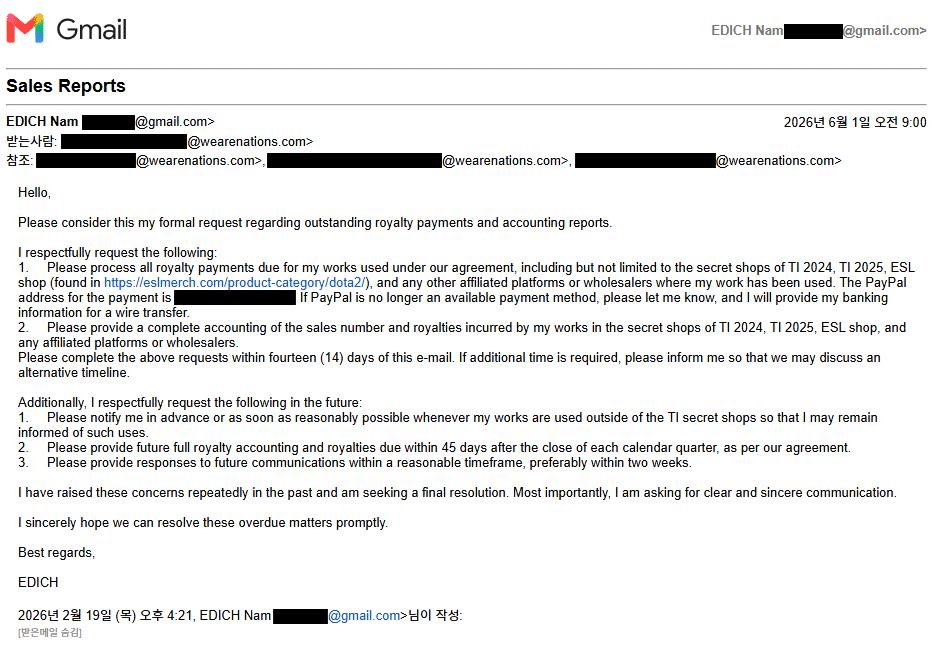
First, an artist going by “EDICH” who previously worked on Dota 2 merch for some of the biggest events in esports, including The International’s Secret Shop and ESL tournaments, published an open letter on Reddit claiming he has not received his royalties after two years.
Then, professional fighting games player 2eZ publicly accused ZEDI Esports of failing to pay players while continuing to operate and sign new rosters. They also warned others against joining the organization.
While these stories suck to hear, neither really surprised me. Payment disputes and delays have been one of esports’ most persistent problems for years. It doesn’t matter whether you’re a player, tournament winner, caster, artist, editor, writer, photographer, or freelancer… Chances are, you’ve experienced a payment delay yourself or at least know someone who has.
If cases like these keep happening every other week, it’s pretty hard to take esports as a serious industry.
Everyone in Esports Has a Payment Story
Payment disputes happen everywhere in the world and in every industry. However, the main issue in esports is how many different stakeholders in the scene experience them. And how often.
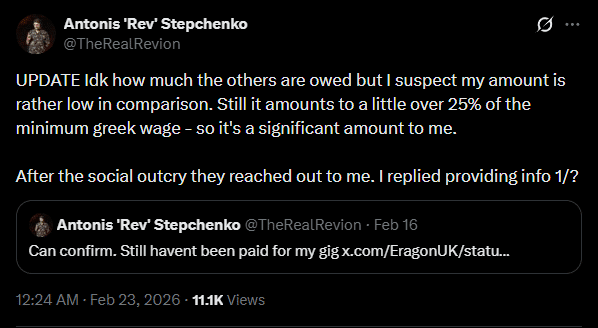
We have seen Tier 1 tournaments failing to pay six-figure prize pools and salaries. Months ago, Esports Insider also covered a story on freelance League of Legends caster Antonis “Rev” Stepchenko not getting paid out.
It’s crazy that we have this, but we literally have an entire debt-tracking spreadsheet in the Dota 2 scene where people who haven’t been paid can jot down how much money they’re owed. Though not everyone listed specific amounts, the amounts included already added up to a reported $3.7 million.
In most industries, unpaid wages are viewed as major failures. In esports, they kind of feel like recurring rites of passage.
It really doesn’t matter if you’re a small-time freelancer or a person who won a huge LAN tournament and played for some of the biggest esports teams – payment issues can happen to anyone.
Esports Runs on Trust
Having worked as an esports freelancer for over five years, I’ve definitely noticed that many business relationships operate very differently from your traditional industries.
I’ve done my fair share of esports jobs, and I can tell you most of my deals have actually been conducted through Discord – the same platform that lets you pay for animated feet on your profile.
Other than Discord, contact would probably go through Telegram. And in many cases, I couldn’t tell you the client’s full name or who they actually were. I just see an alias and random profile pictures that aren’t their faces.
I’ve even sent partnership inquiries to several streamers through email, only to have them redirect me to Discord a few messages later.
I’ve worked with more than 25 clients, yet I can remember signing fewer than five contracts. Sometimes, I don’t even send formal invoices. It’s more like: “Hey, you’re going to pay me, right?”
I’m sure people outside of esports will find that insane, but it’s still surprisingly common throughout this industry. For something that’s supposed to be professional, a lot of esports jobs still run on handshakes and trust. [Editor’s Note: And blind hope and passion.]
Fortunately, I’ve never gone unpaid or faced severe payment delays; a month or two was probably the longest I had to wait. Most people are honest, and the system works – until it doesn’t. But when something goes wrong, the lack of structure becomes a real problem.
The Barrier to Entry Is Incredibly Low
Another reason payment disputes are so common in esports is that the barrier to entry is honestly pretty low. Starting an esports organization is much easier than starting a traditional business.
You can literally wake up one day, come up with a sick team name, get a logo made on Fiverr, create some social media accounts, and suddenly you have an esports organization. Of course, running a successful one is a completely different story, but creating one and making it look a little legit doesn’t take too much time and effort.
Picking up players isn’t that difficult either. Let’s say there’s this unsponsored stack planning to play an online tournament. They were going to compete for free anyway. Then an organization comes and says, “Hey, we’ll pay you X amount of money per month to play under our name.”
For these guys who were going to play the tournament anyway, that’s a very easy yes. Even a small salary sounds like a good deal and an extra bonus. The problem here is that players often have very little information to work with. They don’t know the organization’s finances, who is funding it, or whether it can actually afford those payments.
That’s how you end up with situations where orgs sign players before they’ve really proven they can support them.
The recent ZEDI Esports controversy is a pretty decent example. When the story started making the rounds, there were comments from Indian esports fans saying they’d never even heard of the organization before:
“There’s an Indian organization called ZEDI eSports? I’ve never heard of them before, even though I’m from India. I must say, athletes should do a background check before joining an org.”
“The Indian Esports comm knows of no such org man. Sorry it happened.”
Now, this doesn’t prove the allegations are true or false, but it does highlight how easy it is for organizations to pop out of nowhere. They can enter the scene, sign players, and start operating without having much of an established reputation.
Most people aren’t starting organizations with bad intentions; the problem is that esports makes it very easy to make promises and a lot harder to keep them.
Accountability Is Hard to Find
Payment delays don’t happen every day, and most people in esports are honest. Most deals are eventually sorted out. But when they don’t, what exactly are you supposed to do?
Unlike many traditional sports and industries, esports doesn’t really have a universal system you can turn to when disputes arise. Most of the time, your best option is to make noise on social media and hope the public pressure is enough to get you a response.
That’s why you see so many payment disputes end up going public. People post tweets, Reddit threads, Discord screenshots, and open letters because they don’t really have many other options available.
Legal action sounds pretty neat in theory, but let’s be real: most esports workers aren’t swimming in cash. If somebody owes you a few hundred dollars, hiring a lawyer will probably eat more money than the amount you’re trying to recover in the first place.
You might be protected by labor laws in some countries, but with so much esports work being remote and international, things can get pretty difficult to sort out.
And because a decent chunk of esports business relationships are informal, things can get messy quickly. Maybe there wasn’t a contract. Maybe communication happened entirely through Discord. Or – pretty commonly – maybe the person who hired you wasn’t actually the guy responsible for making payments.
When things are running smoothly, everything’s great and none of that matters. But when payment disputes appear, it’s honestly pretty hard for workers to try getting what they’re owed.
We Gotta Pay People On Time
At the end of the day, esports wants to be taken seriously. We already have million-dollar tournaments, franchised leagues, massive sponsorship deals, and global audiences. We’re even comparing ourselves to traditional sports.
But none of that really matters if we still struggle with something as basic as paying people on time.
Players should get paid. Freelancers should get paid. Artists should get paid. Casters should get paid. Players who fly to tournaments, compete in them, and win them should also probably get paid. This isn’t a controversial take – it’s the bare minimum.
I’ve had the pleasure of working with several clients in the industry, and I’m happy to say that most of them are honest, and most organizations do the right thing. But payment disputes are still showing up on my timeline year after year. This could be a sign that the industry has some ways to go.
If we want esports to be treated like a professional industry, let’s start with something as simple as paying the people who keep it running.