Chess grandmaster Magnus Carlsen was a diminutive silhouette as he sat at the end of the stage where he’d be illuminated at the end of the Esports World Cup’s Opening Ceremony’s opening gambit. Five minutes later, French superstar Aya Nakamura performed one song and left the stage. So too did Theodora, before waltzing up the steps to lay across a Secretlab’s gaming chair.
By the time Team Falcons awkwardly placed the Club Championship trophy on its perch on the stage of La Seine Musicale, it was hard to say what, exactly, the opening ceremony was trying to tell its audience. And I think that’s because it was trying to tell five different audiences, five different things at once.
That’s not necessarily a criticism, but more an explanation. The Esports World Cup’s first opening ceremony outside of Riyadh was built to satisfy more than 100 broadcaster partners across 160 countries, a roster of sponsors ranging from Saudi state enterprises to Lenovo, and a global content pipeline that will take intimate B-roll footage into clips long after the night’s gone.
What it wasn’t built to do – and perhaps never intended to do – was tell a story to the room. As someone who’s been around the industry for a while, I felt entertained, mildly confused, and pretty sure that the show wasn’t made for people like me. Which, I think, is pretty much the whole story.
The Esports World Cup opening ceremony was like a global buffet
In trying to pinpoint the exact feeling I had as I left the venue, bear with me, but I think it was that of walking into a global buffet. You know, the kind with a hundred trays meticulously organized in rows under heat lamps. You’re generally thrilled by the sheer range of it – a chow mein sits next to a Caesar salad, which stares seductively at the arancini.
Opposite you’ve the carvery station within a stone’s throw from the sushi. You load your plate, and forty minutes later, you’re full and ready for bed. You’re struggling to remember what you actually ate, with a palate that’s taken a battering, and you’re wondering whether anything you wolfed down should ever have made it onto a plate together in the first place.
That’s the Esports World Cup’s opening ceremony. Nothing on the menu was necessarily wrong. Carlsen is one of the most recognizable competitive minds alive and an ambassador for the tournament. Nakamura and Theodora are two of France’s biggest exports, and the trophy’s return is typically a key part of any opening ceremony (the Olympic torch being a prime example).
But it wasn’t cooked for any one guest in particular. The arancini lacked the love of an Italian nonna, the biryani the magic touch of a recipe passed down four generations. Composed for the room, the broadcast, the sponsors, and the content machine. Everyone, really, except anyone in particular. Most opening ceremonies are structurally messy, though, and this was no exception.
Aya Nakamura and Theodora were given one song each
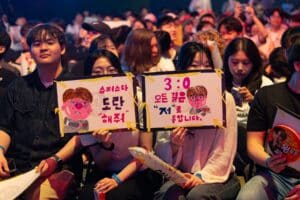
Some of the crowd at La Seine Musicale had come for Aya Nakamura and Theodora rather than esports. Around me, fans sang every word, while others looked just as confused when Magnus Carlsen appeared moments earlier.
Theodora, or Miss Kitoko, leaving the stage on a sponsor’s gaming chair, was a timely reminder that the EWC is still positioning itself and building an identity. The one song inclusion of two French superstars felt a little like a box-tick exercise and lacked the true cultural connection and authenticity I think the bookings were looking to achieve.
For me, it felt almost like shoe-horned evidence that Paris had been included. It felt more like a transactional justification for the line in the press release than an authentic artistic celebration of Parisian culture.
Broadcast partners and sponsors shaped the show
When you zoom out from the stage, the logic starts to make a lot more sense. Once you remember the ceremony was simultaneously serving more than 100 broadcast partners across 160 countries, alongside a sponsor roster stretching from Saudi state enterprises to Lenovo and Hilton, the structure starts to become more understandable.
You can already start to see how it’s almost an impossible task. It’s not a show built for a viewer; it’s a compilation of clips bundled together to portray an image of grandiosity and hype, even if the storytelling is perhaps lost.
This perhaps explains why, bar the trophy’s awkward return to its perch, the occasional appearance of an esports player on stage, and an brief LED flash of players’ faces, there was almost no reference to the tournaments themselves over the course of the night. The tournament often felt like the excuse for the spectacle, rather than the spectacle itself.
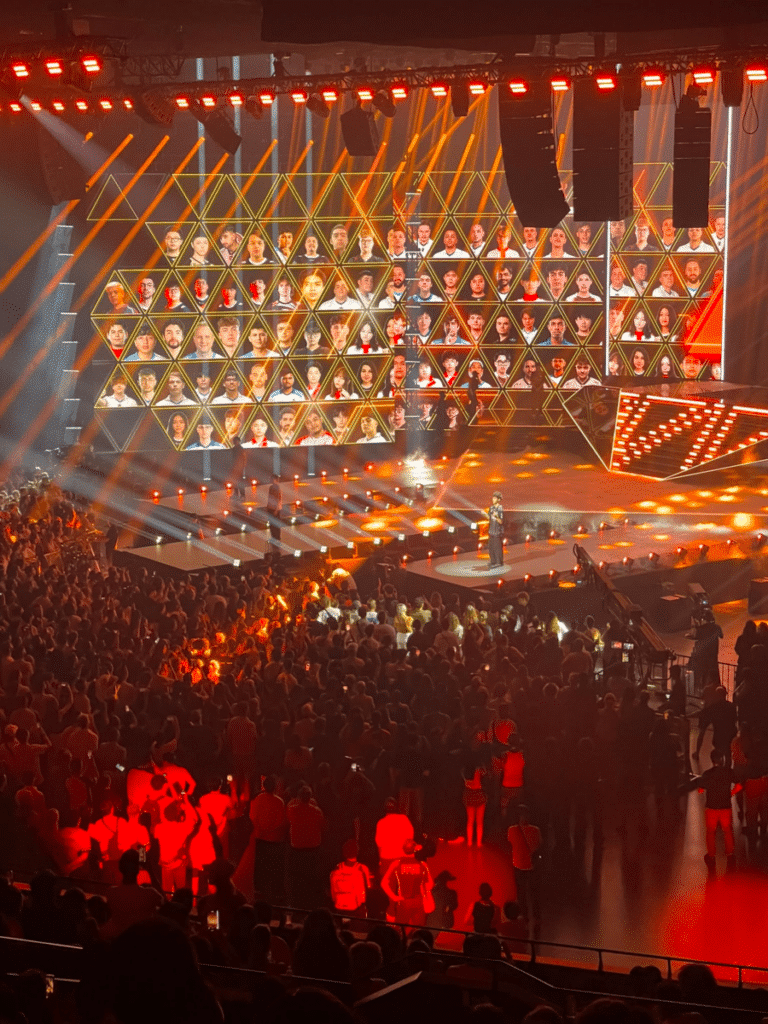
The EWC is selling esports to people outside esports
Again, this isn’t a new theme. I watched the first episode of the Esports World Cup: Level Up documentary on Amazon Prime (and I wholeheartedly recommend it, for Boaster’s story in particular) and the opening collection of clips is all built around celebrity and bravado – speaking to people who are not existing esports fans. Lando Norris, Tony Hawk, Nick Kyrgios, Alisha Lehmann, Cristiano Ronaldo, Brazilian Ronaldo all feature in the first five minutes.
- “If they call me that, I need a performance that matches”: I witnessed the Faker fandom at MSI 2026, and their passion for the GOAT goes beyond traditional sports fans
- The XSE Pro League is a great example of how not to operate esports events
- Leak culture, vagueposting, and oversharing: What we can learn from the FrosT and Global Esports drama
The instinct to reach for recognizable outsiders as a legitimacy signal didn’t start with this opening ceremony but is part of the EWC’s overall operating model and mission: to bring esports into mainstream discussion. The notion of clipping events into hype montages allows the almost clunky-feeling mash-up to persist and serve the purpose I think that was ultimately intended.
Hardcore esports fans were not the target audience
Here’s the thing about a buffet, though: not everyone’s a food-snob like me. A hardcore fan of a specific game, or someone with a firm grasp of esports industry knowledge is closer to a Michelin inspector than your average buffet-goer.
They know exactly what “correct” tastes like within their tradition, and the minute something tastes off, they’ll call it out. If a reference doesn’t land, or isn’t to their specific taste, they’ll vocally make it known.
But here’s the kicker. The buffet was never designed to satisfy a Michelin inspector. It should be judged by an entirely different standard. The aim is for people to leave full, not to spur argument about the authenticity of the Arrabiata. A discerning palate and knowledge of the subject matter is what makes you notice that the pasta dish is underseasoned, or the Pad Thai is inauthentic.
That, I think, is the real distinction between how I experienced the night and how many around me in La Seine Musicale did too. The casual diner doesn’t send anything back; they just shrug and head back for another pop at the spring rolls.
The opening ceremony was fine, even if it was not made for me
Which brings me to the part of this I don’t want to get lost under everything above: it was fine. Genuinely. As an esports fan specifically, this ceremony wasn’t built for me, and I’ve made peace with that over the course of writing this.
The list of broadcast partners and sponsor list is imperative to run an event of this scale – a fact oft forgotten by esports fans as they sit and lap up content at home. A $75 million prize pool, taking over one of Paris’ biggest expo-venues for seven weeks and state-of-the-art event production does not happen on the ‘enthusiasm’ of die-hard esports fans alone.
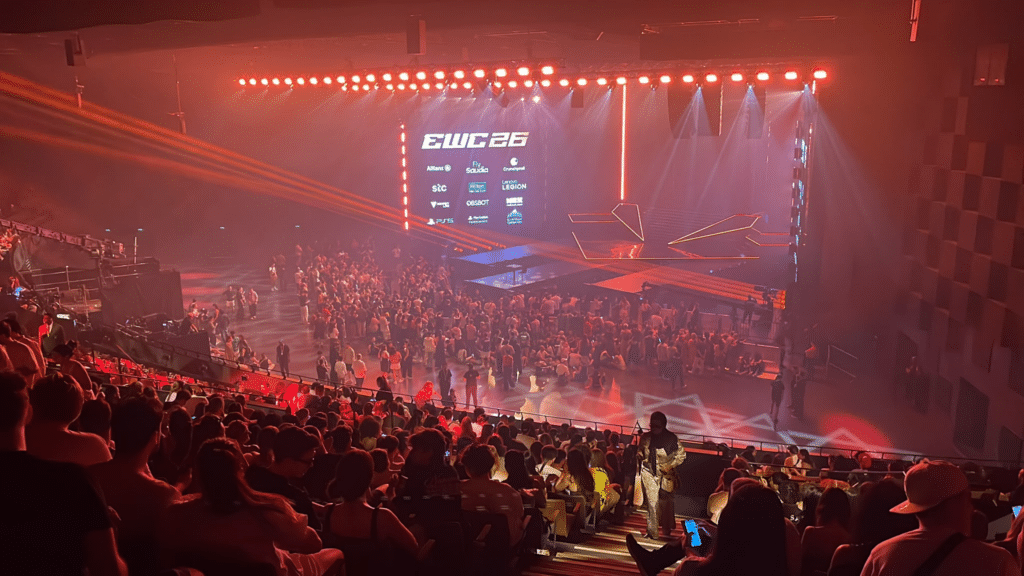
It happens because the EWC has built and packaged a product that has convinced broadcast partners and a wall of sponsors that this is worth their time and money. It’s the mechanics that take esports from a niche hobby into something that commands discussion in one of Europe’s great cities for an entire summer.
It’s also worth saying plainly: getting anything with that star power on stage in the short time-frame they had is fairly impressive. Speaking to folk in the industry, the planning for the League of Legends World’s opening segments starts 18 months prior.
The EWC had a fraction of that time and still managed to put on a show that looked the part. The thing that made the opening ceremony feel diluted to me is the same thing that has made esports bigger, richer, and more visible than ever before. I don’t think these two facts cancel each other out; I think they’re just true at the same time.
Esports fans are naturally suspicious of change
There’s a broader conversation around esports fan culture to be had. In fact, there’s probably a book to be written about it. Esports fans have a reflexive suspicion of anything that reaches past the status quo.
It’s like an inherent defensiveness that can look like protecting the scene, but is also deeply rooted in fear of change and of the little community they’re part of being shaped by corporations. I suspect some of my own initial gut reaction had some of that baked in, too.
Not every guest at a buffet needs to be a food critic. Most people just want to leave full, and by that measure, the EWC’s opening ceremony did its job. The footage is already being chopped up and heads for next year’s sponsor deck. Someone will see it, a chess grandmaster, superstar DJs, a familiar face in a gaming chair, and have their interest piqued. That’s more than enough for a crowd that’s never heard of half of the games being played in Paris over the next two months. I just wasn’t the diner they were cooking for.
Disclosure: Travel and accommodation for this event were provided by the Esports World Cup. The Esports World Cup had no editorial input into, or approval over this article.