It’s no secret that professional Dota 2 players have been breaking MMR records like twice a year. Most recently, we had PARIVISION’s wonderkid Alan “Satanic” Gallyamov breaking the 18,000 MMR milestone, becoming the first in the world to do so.
However, nobody really celebrated this accomplishment… Not because it isn’t impressive, but because it happens all the time now. Like, Satanic reaching 18,000 MMR just doesn’t hit the same as Amer “Miracle-” Al-Barkawi reaching 9,000 MMR 10 years ago. And the main reason for that is that the MMR system has just become too inflated, like for real.
Well, the “MMR inflation” has certainly become a big enough issue for Valve to take notice, as they recently rolled out massive changes to the Immortal MMR system in the Summer Scrub update.
- “Dota 2 salaries are inflated”: Tundra Esports founder reveals expenses of a Tier 1 Dota team and the scene’s struggling economics
- Warzone esports is at risk of being ruined by controversial audio tunes
- “The struggle has to exist!”: The FGC is finally realizing games don’t have to be hard to be good
The issue with the MMR system
Many players will agree that the MMR system has gotten super inflated, and the root cause is believed to be the Double Down tokens that let you win twice the MMR from a single match. Or, maybe players have just gotten better in general – that’s also very possible.
However, inflation in the Immortal bracket is pretty clear. According to Stratz’s database, the Immortal rank was only home to the top 1% of players in 2023. However, it has now ballooned to around 4.4% in 2026, meaning we have almost four times as many players in this rank as we used to.
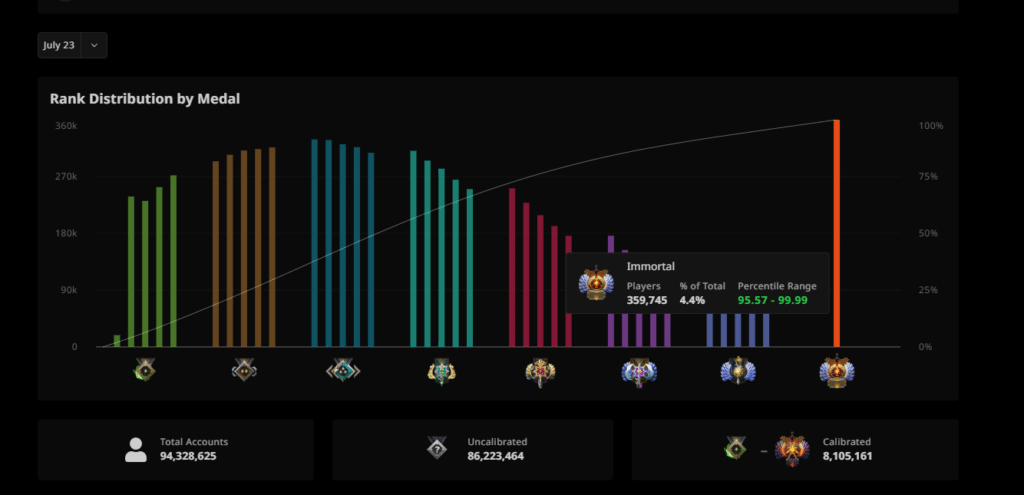
I mean, I see several people on Reddit posting screenshots of reaching the Immortal bracket almost every day – the rank just doesn’t feel as exclusive as it used to be now.
Back then, once you reached the Immortal rank in Southeast Asia, you’d immediately find yourself on the leaderboards as one of the top 5,000 players in the region. In 2026, you’d have to reach around 6,900 MMR to get your leaderboard rank.
But the real problem was the scale. MMR in this bracket had crept up to the point where the top players literally had 16,000 to 18,000 MMR. The gap between them and a fresh Immortal player was over 12,000.
To put it into perspective, the distance between a Herald player and an Immortal player is 5,000.
What did Valve change about the MMR System?
So, the MMR system was a little scuffed. That’s why, in the most recent Dota 2 update, Valve announced new changes to the ranked system – particularly in the Immortal bracket.
The changes in the patch notes are as follows:
- Immortal Rank players have had their MMR adjusted. All players are now between 1 and 9500 MMR
- The cutoff for Immortal Draft is still 8500
- Relative player placement and leaderboard positions are unchanged
So, they didn’t do a full MMR or anything and turn matchmaking into the Wild West – they pretty much just shrunk every Immortal player’s MMR. Satanic, who was the highest-ranked player in the world at 18,000 MMR, was dropped down to 9,462 MMR. This means there are no players in the five-digit mark anymore – for now, at least.
Relative leaderboard positions are also preserved, meaning if you were ranked #2,500 in the leaderboards, you’re still #2,500 after the update – it’s just that the numbers attached to your profile shrank.
Artour “Arteezy” Babaev was extremely pleased with the new update. The smaller gap meant he was able to consistently get into top-level pubs.
He said: “Because the MMR was reset, I can actually get into high-skilled lobbies again and not have to play with ghouls every day. It’s actually so enjoyable to play in human games, dude.”
What does the MMR deflation mean?
So, everybody’s numbers got smaller, but what do these changes actually mean? Here are my takeaways on this change.
Immortal Draft
This is probably the biggest change. Immortal Draft has had its fair share of issues, mainly that players abuse the drafting system to win-trade and that the Avoid Player feature doesn’t work in this game mode.
So, Immortal Draft still exists, and the threshold is unchanged at 8,500 MMR. However, since everyone’s MMR has been crunched down, the pool of players eligible to play in these matches is much smaller. You’ll mostly only see pro players in these lobbies.
Potential deranking
The floor of the Immortal rank still hasn’t moved, but now, there are way more people who are barely over the MMR cutoff. Players who were previously around 6,000 to 7,000 were sent all the way down to sub-6,000.
Now, since there are a lot of players standing right above the floor, we might see an all-out brawl down there, and a bunch of them might even derank back to Divine. This is an unconfirmed consequence, but it’s logically a very real possibility.
This, in my eyes, is a right step into making the Immortal rank feel exclusive again. If you want to stay in this bracket, you’ll have to prove it.
More incentive to try harder
Many, many Immortal players, especially those with something like 15,000 MMR, tend to give up on games pretty early. The reason is that the game already seems lost, and it’s better to save time and queue up for the next game.
This mindset makes total sense if you’re in their position. You have 15,000 MMR, so losing 25 is like losing 0.1% of your total MMR.
But now, with the compressed scale, the psychology changes quite a bit. The former 15,000 MMR players are now at around 8,000 MMR, so losing the same 25 MMR is going to sting.
Wins and losses mean much more, so there’s more incentive to actually fight until the bitter end – which is how Dota is meant to be played.
It’s easier to grind now
In my opinion, this is the biggest effect. So, I’ve been hovering around the 8,000 MMR mark in Southeast Asia, putting me around the top 2,000 players in the region. I’m not the best player, but I’m definitely not too shabby.
However, it’s been pretty demoralizing for me to try and increase my MMR, mainly because the gap between the number one player in my region and me is over 8,000 MMR – the guy is literally double my MMR. I’d have to grind 12 hours a day, with no guarantee, to try to reach such ranks.
All of a sudden, the MMR gap between the number one player in the whole world and me is now only around 3,000 – it’s no longer 8,000 to 10,000. That is a huge difference, and definitely one that gives me a little bit of copium. Climbing doesn’t feel impossible anymore, and this change has given me motivation to get back in the grind. I’m pretty sure many other inactive Immortals are also going to give it another shot.
The MMR shrink is also an extremely healthy change for the esports scene. Now is the perfect time for talented rookies to come into fruition. Some of these kids have school and can’t spend 12 hours a day grinding ranks, and it’s pretty hard to climb like this when the top players have so much MMR. But now, as long as they have a positive win rate, they’re going to climb really fast and accelerate their chance of proving themselves.

All in all, I’m a huge fan of this new update. I’ve always been chasing leaderboard ranks – not raw MMR – so I couldn’t give two hoots about losing around 1,500 MMR.
Every game feels more meaningful, and climbing is much easier, which benefits empl*yed players and promising talent.