TL;DR
- CS2 features two ranking systems: Competitive mode with 18 ranks from Silver 1 to Global Elite, and Premier mode, which uses a numerical CS rating from 1,000 to 30,000+.
- CS2 ranks are tiered into six major groups, and advancement is based on performance, win streaks, and gameplay against similar or higher-ranked players.
- In Premier mode, players receive a CS rating and leaderboard placement after winning 10 matches.
- CS rating is colour-coded, ranging from Grey → Light Blue → Blue → Purple → Pink → Red → Yellow as you climb up.
- Less than 1% of players reach the Global Elite rank or a CS rating above 30,000, marking them among the best in the world.
- To rank up faster, players should focus on improving aim, map knowledge, smart economy usage, and practising regularly using custom training maps.
Whether you’re jumping back into Valve’s shooter phenom, or have been wanting to get involved to see what the fuss is all about, you’ll want to know how the CS2 ranks and rating system works. Since Counter-Strike 2 replaced CS:GO in 2023, a section of players has asked for a streamlined competitive experience, and Valve has obliged.
While Valve has kept the old Competitive ranks, a Premier, numerical CS rating and leaderboard system has also been added. This means you can have a competitive rank per map (CS:GO style) and a single global Premier CS rating that sits on a leaderboard.
As CS rating is split across two forms of ranked play, Competitive and Premier, your rank will depend on how well you do in that respective game mode. Competitive lets you choose any map you like and queue for it, standardising progression like CS:GO, but Premier is a stricter system that allows bans for maps, forfeits, and fewer choices.
It can feel complicated, so we’re explaining CS2 ranks in order and how they’re different from ratings. This includes the highest rank possible in CS2, how you can get there, stay there, and the difference between the two game modes.
All CS2 ranks
How does CS2 ranking work?
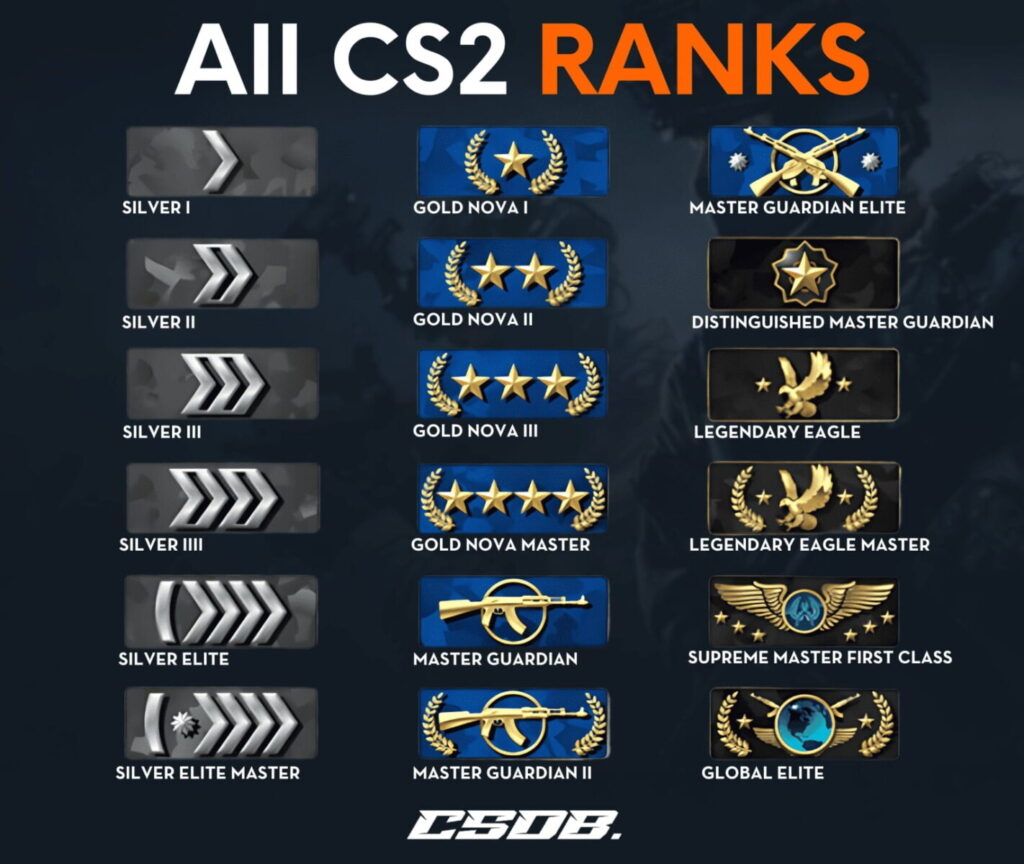
From Silver to Global Elite, there are 18 competitive CS2 ranks in total for the game’s Competitive mode in 2026.
You climb the ranks by winning and playing well in matches, with consecutive wins resulting in a faster climb up the ranks. Valve has also stated explicitly that a good performance (not just a win) determines rank adjustments. There are hidden MMR and rank calibrations for each map in Competitive, meaning you can rank differently per map. Just because you win on one map doesn’t mean your ranking climbs on another.
CS2 ranks explained – Full list of CS2 ranks available
- Silver 1
- Silver 2
- Silver 3
- Silver 4
- Silver Elite
- Silver Elite Master
- Gold Nova 1
- Gold Nova 2
- Gold Nova 3
- Gold Nova Master
- Master Guardian 1
- Master Guardian 2
- Master Guardian Elite
- Distinguished Master Guardian
- Legendary Eagle
- Legendary Eagle Master
- Supreme Master First Class
- Global Elite
While things are similar to the previous game, CS2 ranks compared to CSGO ranks have some differences.
The 18 ranks are spread across six tiers. These ranks improve as you win games, support teammates, maintain a healthy frequency of kills, and how well you play compared to others of a similar or higher rank than you. These six tiers are as follows:
- Silver
- Gold Nova
- Guardian
- Eagle
- Supreme Master First Class
- Global Elite
Silver 1 is the lowest rank in CS2, generally being where those with little FPS experience start. Depending on your in-game performance, you should be able to clamber out of Silver if you can string together 10 or more match wins in a row, boosting you into the next tier.
The CS2 highest rank is Global Elite – the maximum level a CS2 player can reach. However, achieving Global Elite on all maps is exceedingly rare; many top players only have Global ranks on a few maps.
CS2 rating system explained
The new CS2 rating equivalents to rankings will depend on how well you’re performing in the game. The full range goes from 1,000 up to 30,000+ and is colour-coded with Gray at the lowest and Yellow at the highest level.
To increase your CS rating, you obviously need to play well. Premier uses an Elo-style system, with the overall rating number and colour corresponding to your rank. After 10 placement matches, you earn points for each match based on the match’s result and opponent’s rating. Winning a match against higher-rated players will give you more points, and the leaderboard updates as you play, with seasonal resets shifting the whole ladder.
Now, let’s view the detailed CS2 rank comparison with ratings.
CS2 rank equivalents: CS2 ratings –> CS2 ranks
- 0 to 4,999(Gray)→ Silver 1 to Silver Elite Master
- 5,000 to 9,999 (Light Blue) → Gold Nova 1 to Gold Nova Master
- 10,000 to 14,999 (Blue) → Master Guardian to Distinguished Master Guardian
- 15,000 to 19,999 (Purple)→ Legendary Eagle to Legendary Eagle Master
- 20,000 to 24,999 (Pink) → Supreme Master First Class
- 25,000 to 29,999 (Red) → High Supreme
- 30,000+ (Gold) → Global Elite
These buckets are useful to compare skill across modes, but remember that Competitive is per-map and Premier is a unified rating. So you might be 18k Premier (Purple) but only Legend-level on certain maps in Competitive.
CS2 premier mode & leaderboards

Learning how CS2’s Premier ranks work is relatively straightforward once you understand the ranks and how they correspond to your rating.
The Premier Mode allows players to ban a map, but does not allow them to choose a map or mode. These map pools can change between seasons, with the current active map pool being made up of seven playable areas:
- Ancient
- Anubis
- Dust II
- Inferno
- Mirage
- Nuke
- Overpass
Each CS2 season rotates the map pool, typically every few months. This should give players enough time to intimately learn the Counter-Strike 2 maps, and if people get tired of Dust II or Nuke, for instance, they can be banned from the roster. After winning 10 matches, you will be given a CS rating, which will place you on the leaderboard.
You can keep tabs on the CS2 leaderboard with dedicated websites such as CS Stats, which tracks players’ wins, current rank, best-ever rank, and their last match played. This source estimates that less than 1% of players are in the rank of Global Elite (with a CS2 rating of above 30,000).
There are other tracking sites and community databases, such as TotalCS, Tradeit, DMarket, and HLTV. These also cover Premier rating distributions, the top players, and leaderboard snapshots. Using multiple sources for cross-checks is recommended, as each site uses samples from different datasets.
Many of the best CS2 players in the world will be at this elite level. Top players according to Tradeit include:
- ZywOo (part of Team Vitality)
- M0nesy (G2 Esports)
- Donk (Team Spirit)
- Xantares (Eternal Fire).
To aspire to be at their level, you need to play a ton of Counter-Strike 2 and practice extensively.
Tips to rank up faster in CS2

There’s no silver bullet solution for how to rank up in CS2 other than improving your fundamental skills, and you can only get better by consistently playing and practising often.
Everyone starts at Silver 1 once they’ve played enough games to earn a rating, and to move up into the major leagues, there are a couple of things you need to do.
1. Work on your aim & movement mechanics
It sounds obvious, but the most important way to improve in CS2 is to have the hours and experience. Counter-Strike 2 may be simple in theory, but its skill ceiling is incredibly high, and this becomes apparent when going from casual to ranked.
Mastering the precise aiming mechanics on the shooting range is the first thing you must do before even thinking of climbing out of the Silver ranks. There are some good Steam Workshop maps that you can download to heighten your skills, including Aim Botz, Fast Aim/Reflex Training, and Recoil Master – Spray Training.
As of January 2026, there are 54 CS2 weapons, including 10 pistols, 11 rifles, seven SMGs, six heavy weapons, and a variety of knives for getting in close. Each firearm functions differently, with each having its own recoil, spread, and damage output affected at different distances.
While you may have a preference for pistols, rifles, shotguns, or heavy firepower, you’ll need to have a fundamental understanding of how they all function on the range before playing competitively, as each gun will best suit different maps and situations. Valve also rotates small weapon tuning changes through updates, so the exact damage and spread numbers shift. It’s best to learn the current recoil patterns on a training map and follow the patch notes for gun tweaks.
CS2 movement is unlike many other FPS games, as you won’t be running and jumping around like in Apex Legends, Doom, or Fortnite. Instead, it’s a much slower and deliberate game, which means you must get used to crouch-firing in short and controlled bursts instead of running and gunning.
You move faster in CS2 with a knife equipped compared to running around with an LMG or rifle, so getting used to quick swapping between weapons with the number keys or mouse scroll is vital. It keeps you mobile, which could be the difference between winning and losing. Counter-strafing is also vital for movement, being extremely useful for crisp aim in duels.
2. Learn the maps
With a game that uses chokepoints as much as CS2, learning map layouts is vital to improving. This is made a little trickier with CS2 Premier maps rotating each season, with seven active at once. It’s similar to CS2’s Competitive map pool.
As a result, it’s recommended that you load into these maps (either playing solo in practice or in unranked casual) so you can become familiar with the corners, chokepoints, and notable locations. Popular maps like Dust 2 will have been figured out more thoroughly than Ancient or Nuke, for instance.
Use offline practice to set grenade lineups, and also practice common smokes and flashes, and study pro demos to learn common strategies. Many sites and creators publish up-to-date utility guides per map after each patch or season change, so they’re very helpful. Also, beyond just memorising important spots, focus on how sound works on each map. Footsteps, reloads, or scope-ins can be heard from different ranges depending on the walls and hallways. Knowing where sound travels lets you bait enemies or catch them off guard.
3. Spend money wisely
Every CS2 weapon costs something to unlock at the start of the round, and not all firearms are made equally. It’s believed that the AK-47, M4A4, AWP, Desert Eagle, and TEC-9 are superior options to the Nova, Dual Berettas, Bizon, R8, and Sawed-Off in some metas.
Take the price of the AK47, for instance; it costs $2,700, compared to the M4A4 at $3,100. Both teams start the game with $800, with the winners of each round getting $3,250 and the losers only receiving $1,400. In Competitive and Premier, you also need to buy gear like Vests ($650), Helmets ($350), and grenades.
One mistake newer players make is over-buying utility every round. Sometimes, holding onto cash for rifles for the next round is smarter than spending $2,000 on grenades when you only have pistols. Always think two rounds ahead.
Communicating with your team about economy is just as important as the aim. If three teammates save and one person full buys an AWP, that AWP will often be wasted. Coordinated strategies make your money go much further, and that directly leads to more wins.
Conclusion
While the CS2 ranking system and rating can be intimidating at the start, now you should understand what they are, all the ranks, and how you can climb up those ranks.
Playing Counter-Strike 2 can be a tough proposition beyond a casual level, and going from Silver 1 all the way to Global Elite is a journey that very few are able to achieve. If you have the time, talent, and put in the effort, you could be one of the best CS2 players in the world.
A part of what makes CS2 different from other shooters is how vital teamwork and communication are at every rank. Even at the lower ranks, like Silver and Gold, good communication and effective utility usage can win rounds, even if your opponents outmatch you one-to-one. Being a better teammate makes you a better CS2 player.
FAQs
How do I see ranks in CS2?
You can see your CS2 rank on the leaderboard which will be highlighted in blue. It will give you your CS rating number, which collates to one of the 18 ranks available in the game.
What are the ranks in CS2?
There are 18 ranks in CS2, ranging from Silver 1 up to Global Elite. They correspond to the CS rating, which starts at 1,000 (once you’ve won around 10 games) and goes up to 30,000, which is colour-coded from Gray to Yellow.
How do CS2 Premier ranks work?
When playing CS2 Premier, you’ll improve your CS rating rather than your rank, which is improved by playing in Competitive mode.
What’s a good CS2 rating?
It’s believed that a CS Rating of between 5,000 and 9,999 (Blue) is considered a good level for most competitive players who have a firm grasp of the mechanics. The league above, 10,000 to 14,999 (Dark Blue), is considered more akin to professional CS2 players, with less than 1% of the player base holding a rating of over 20,000.
How to get ranked in CS2?
To get ranked in CS2, you need to win around 10 matches in either Competitive or Premier mode. After that, you’ll receive a Competitive rank or a CS rating in Premier based on your performance.
REFERENCES
- CS2 Leaderboard (CS Stats)
- Best CS2 Players of 2026 – TOP 20 (TradeIt)
- Counter-Strike 2 (Steam)
- How to Check Rank in CS2? (CS2Pulse)