TL;DR
- Overwatch 2’s ranked system is split into nine tiers with five divisions.
- Players will start at division one within a rank and will need to level up and max out division five to progress to the next tier.
- At the time of writing, January 2026, official stats note that most players are in the Platinum and Gold tiers.
- To rank up fast, be sure to choose specific heroes, practice as much as you can, find a good team, and utilise effective communication methods.
Like any competitive online game, Overwatch 2 has a rank system with different tiers and divisions for its players to climb. Theoretically, Overwatch 2 ranks group players together with similar skill levels, allowing them to improve as they climb up the ladder.
The Overwatch 2 ranking system adjusts and updates the game every season, but the general tier and rank system has remained largely the same since the original Overwatch’s run. For instance, some game modes come and go for competitive Overwatch, like Lúcioball.
If you want to know more about the Overwatch 2 rank system, so you too can join in on the competitive grind, as well as how to rank up quickly, this is the place for you.
Overwatch 2 ranks and tiers explained
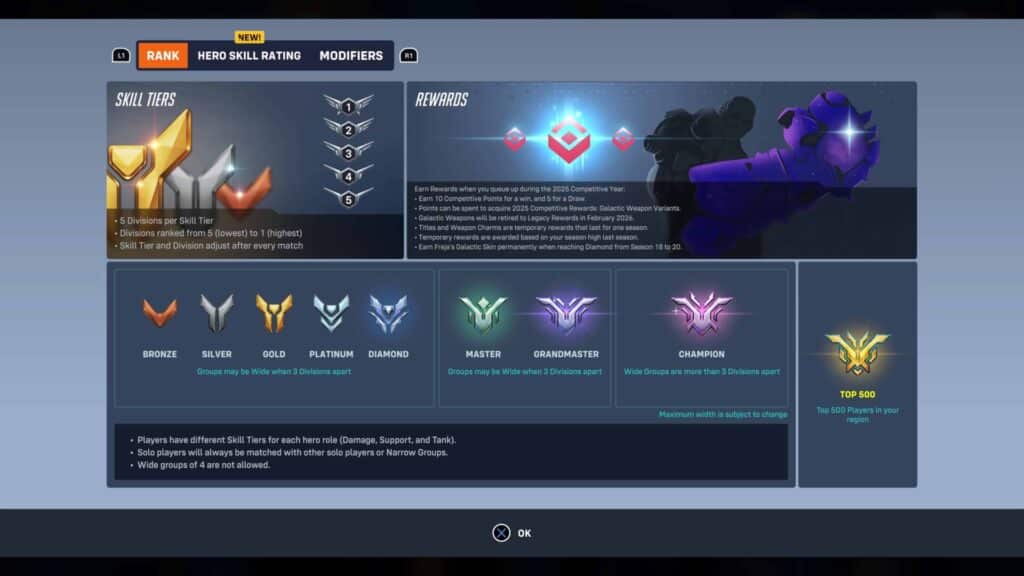
The Overwatch 2 rank system is split into nine separate tiers, each of which has five divisions. The lowest rating within a division is one, and the highest is five. To progress through the tiers, players have to rank up from level one to level five within each division. Once this is done, they will move on to the next tier.
For example, let’s say that a player has been put into the Bronze tier after their placement matches. Within that tier, they will start at level one. They can then rank up through the Bronze division by winning competitive games. Once they have maxed out the level five division within Bronze, they will rank up to the Silver tier and begin the process again.
The tiers and divisions in Overwatch 2’s competitive mode are as follows:
| Tier | Division score range |
|---|---|
| Bronze | 0-1499 |
| Silver | 1500-1999 |
| Gold | 2000-2499 |
| Platinum | 2500-2999 |
| Diamond | 3000-3499 |
| Master | 3500-3999 |
| Grandmaster | 4000-4499 |
| Champion | 4500-5000 |
| Top 500 | Special leaderboard, no specific division score. Given to the best 500 players in each region, regardless of their rank. |
How the Overwatch 2 ranking system works
Before being assigned one of the ranks in Overwatch 2, Competitive mode has to be unlocked. It is only available once a player has won 50 games in Quick Play, save for those who had purchased Overwatch 1 before it became Overwatch 2. They can play competitively immediately.
The three different roles in the game: Tank, DPS, and Support, have separate ranks, obtainable through Role Queue in the competitive mode, allowing players to choose their role. Ranks can also be obtained in Open Rank, which is universal across the three classes, allowing players to choose any heroes.
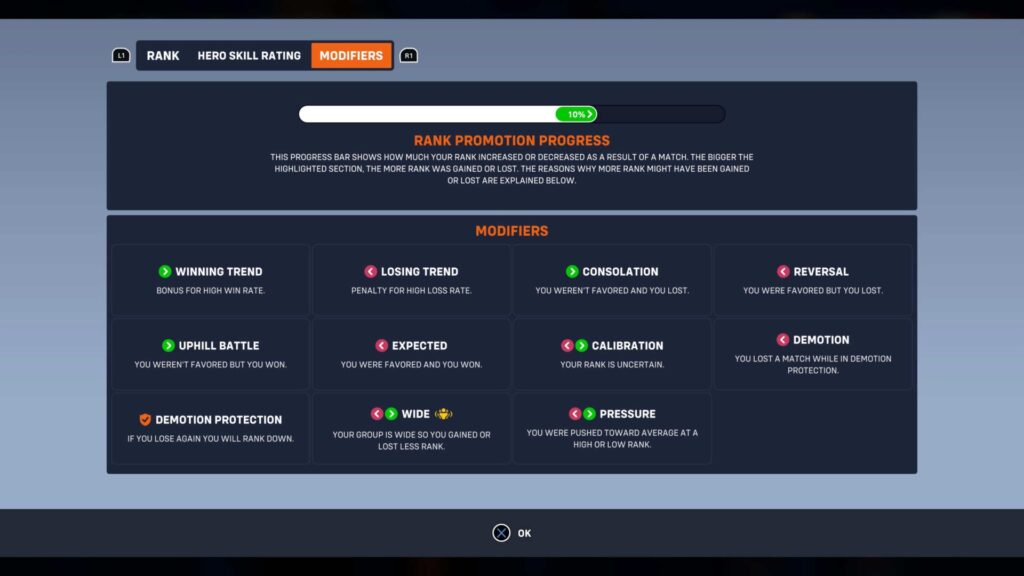
A player’s rank is determined by more than just a win or loss during a placement game. Promotion to a new rank is affected by modifiers, seen in the image above. These modifiers are winning and losing trends, and whether your team was favoured to win.
Those you team up with or battle against are determined by your Matchmaking Rating (MMR). This is a hidden statistic and is a significant factor for matchmaking in Overwatch 2 ranks.
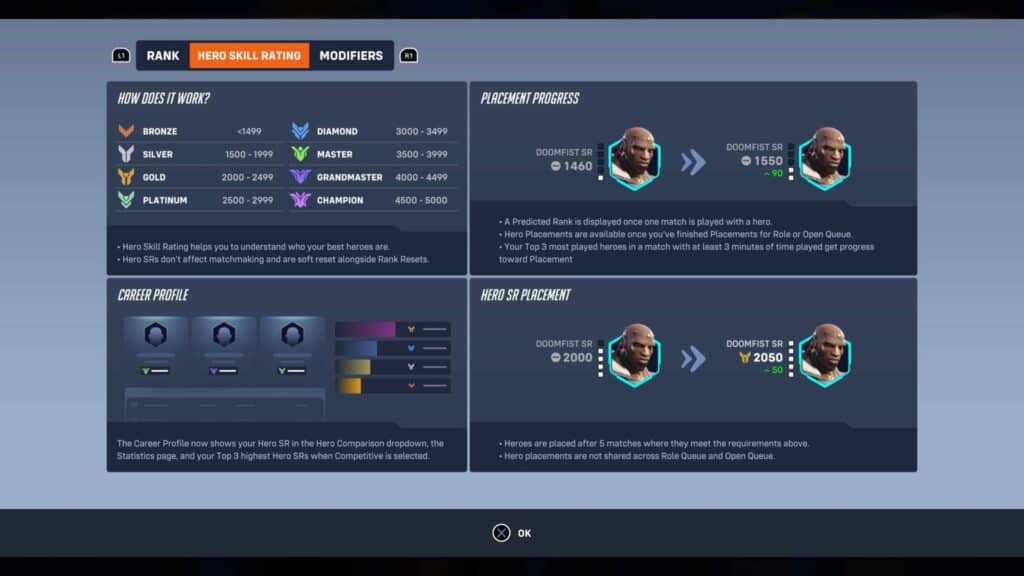
As of season 18, a new system called the Hero Skill Rating–or HSR–was implemented to track the player’s performance with individual heroes. This is separate from your overall ranking, but it does add a bit more detail and depth to each player’s personal stats with each hero.
As of season 20, the most recent as of writing, another new system was introduced, called Challenger Tier. The top 500 leaderboard has been replaced by this Challenger Tier, where the 500 best players per region are decided by their Challenger Score. You need to be in the top 500 to have your Challenger Score displayed on a leaderboard, but your score will also appear on your player profile.
Rank distribution in Overwatch 2
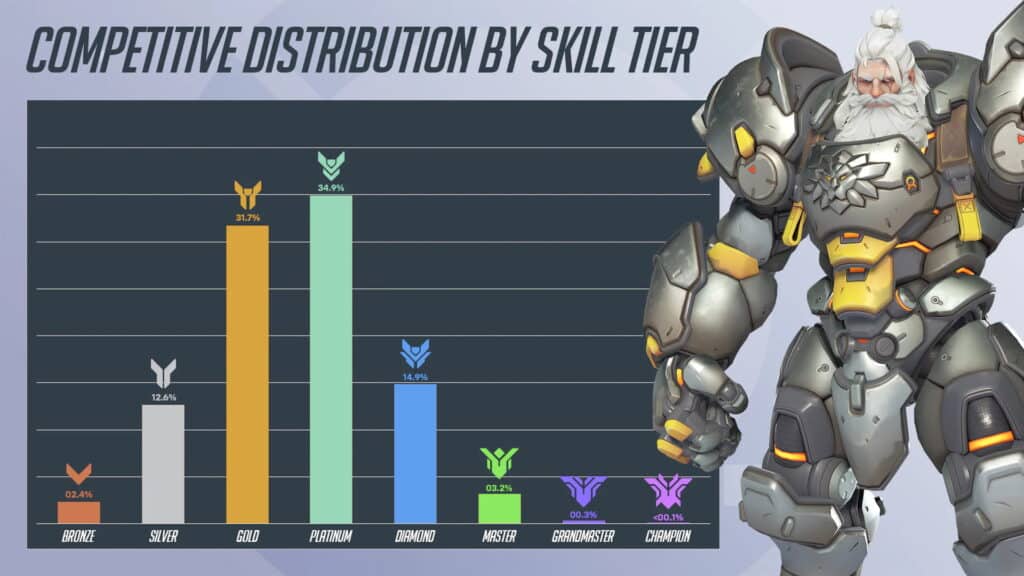
As of writing, January 2026, there hasn’t been any new, official information about Overwatch 2 ranks distribution. The latest information we have received came in July 2025, from an official blog post by Blizzard for season 17. According to these stats, 34.9% of players were in Platinum, while 31.7% were in Gold. This meant that around two-thirds of all competitive Overwatch 2 players were in these two ranks. The data also shows the percentage of the other ranks, which are as follows:
- Bronze: 2.4%
- Silver: 12.6%
- Diamond: 14.9%
- Master: 3.2%
- Grandmaster and Champion combined: 0.3%
Take this data with a grain of salt, as distribution is subject to change with each season, and this is the most recent official data we have.
How to rank up faster in Overwatch 2
To rank up faster in Overwatch 2, there are a few tips and tricks to consider. Firstly, find the hero that suits you best, preferably one within each role. It’s better to try to build your skills with a few heroes rather than trying to play as a broader range of characters. If you’re willing to try any hero, our Overwatch 2 tier list will provide insights on which characters are the best to play with in the game’s current meta.
Learn the ins and outs of your chosen hero, from their ultimate abilities to the most effective positioning for them. Stay focused and try to build chemistry with your team. For example, if you are playing as a Support, be aware of the health bars and positions of your allies at all times.
On the topic of teammates, communication with the team is key. Using a mic is ideal, but if that isn’t possible, or you don’t feel comfortable enough to do so, utilise the ping system and text chat to communicate. For consistency and more enjoyment, play with friends or people you know are capable. If you can form a consistent, well-rounded team with all the classes covered, it will certainly help you go up the ranks.
These are just a few tips to help you rank up quickly when playing Overwatch 2. Remember to focus on winning your games by communicating with teammates, improving your skills with your chosen heroes, and adapting to both the game meta and the needs of the team.
Rank decay in Overwatch 2
Overwatch 2 no longer has a rank decay system, as it was removed in April 2023. At the time of writing, January 2026, players will not experience drops in rank when they do not play the game. Instead, their rank will be maintained until the season resets or they return to the game.
The rank system in Overwatch 2 has had a few changes since the game was first released in 2022. However, the general structure of tiers and divisions remains the same. If you want to start rising through the Overwatch 2 ranks, be sure to practice with your chosen heroes and implement effective communication, tactics and strategies when jumping into a Competitive game.
Conclusion
While Overwatch 2’s rank system has remained structurally the same, Blizzard’s changes, such as the season 20 Challenger Tier system, prove that it wants to keep the competitive side of the game thriving. This hasn’t quite translated to the esports side, but Overwatch 2 ranks have kept players hooked for almost a decade.
If you want to embark on a journey up the ranked ladder, learning how they work is vital to that process. Perhaps you will end up with a Challenger Score worthy of a top 500 ranking on the leaderboard.
FAQs
How to rank up fast in Overwatch 2?
As mentioned above, there are a few ways to rank up fast in Overwatch 2, including the following methods:
• Choose a few heroes and build skill with them
• Avoid being too open with hero picks
• Pay attention to the current meta of the game and choose your hero accordingly
• Find or build a team that works well and play together when able
• Make use of the in-game communication systems, such as pings
•Review match replays to examine your performance
• Practice makes perfect, so practice whenever you can.
How does the ranking system work in Overwatch 2?
The ranking system is split into tiers and divisions. To level up, the Overwatch 2 ranked requirements revolve around reaching the score bracket of each tier.
What are the different ranks in Overwatch 2?
At the time of writing, the rank tiers in Overwatch 2 are as follows:
• Bronze
• Silver
• Gold
• Platinum
• Diamond
• Master
• Grandmaster
• Champion
• Top 500
How many divisions are in each Overwatch 2 rank?
There are five divisions within each Overwatch 2 rank, with one being the lowest and five being the highest.
What are the lowest and highest ranks in Overwatch 2?
The lowest rank in Overwatch 2 is Bronze, while the highest is Top 500. It could be argued that Champion is technically the highest rank in general, as Top 500 focuses on the highest skilled players of each region, no matter what their rank is.
How often does rank reset happen in Overwatch 2?
Rank resets happen with each new season, though hard resets are less common than soft ones. Hard resets occur when major changes happen in the game, such as with season 18, the most recent season at the time of writing.
What percentage of players are in each Overwatch 2 rank?
According to the aforementioned blog post from July 2025, the percentage of players in each Overwatch rank is as follows:
• Bronze: 2.4%
• Silver: 12.6%
• Gold: 31.7%
• Platinum: 34.9%
• Diamond: 14.9%
• Master: 3.2%
• Grandmaster and Champion combined: 0.3%
Be aware that this is likely to change in the future, but as of January 2026, most players can be found in Platinum rank, with Gold rank following soon after.
REFERENCES
- Weekly Recall: Up To The Challenge (Blizzard)
- Weekly Recall: Meet Your Matchmaker (Blizzard)