A new VALORANT esports tournament has emerged in the EMEA region with Project Blender, an open-to-all-players event, announced earlier today.
Complete, with a unique format and reward system, here is everything fans need to know about the new VCT Partner Series competition.
Project Blender will be divided into four tournament phases taking place between October and December this year. Phase 1 features a single-elimination, open bracket format with 1024 teams.
Moreover, mixed-gender rosters can participate in the ‘Blender Spotlight’, which will give the winning team a direct Phase 3 buy-in. The second and third place will regularly advance to Phase 2.
Phase 2 will kick off in November with two weeks of round-robin competition. From the 64 total teams, 16 have qualified through Project Blender Phase 1. The remaining 48 squads hail from EMEA’s Challengers, Game Changers, Premier and VALORANT Regional Circuits (VRC).
Project Blender will conclude in December with Phases 3 and 4. The first week of competition will see 32 squads fight through a Swiss Stage and a single-elimination bracket. Phase 3 may also include VCT EMEA teams.
The top eight rosters will then advance to the Finals Phase held in a LAN environment.
Blender Draft and Challengers Call
VALORANT’s new tournament also sets itself apart through its one-of-a-kind drafting and seeding system.
Similar to League of Legends’ ‘Fearless Draft‘, Project Blender places restrictions on agent composition choices throughout a series.
According to ‘Blender Draft’, teams can select any agent for the first game of a series. For map two, however, all agents previously picked by that team will be banned. The third draft then bans all map two agents.
The tournament’s seeding system is called ‘Challengers Call’, which allows teams that have qualified through Phase 1 or 2 to choose their opponent for Phase 2 or 3.
Project Blender’s Bounty System
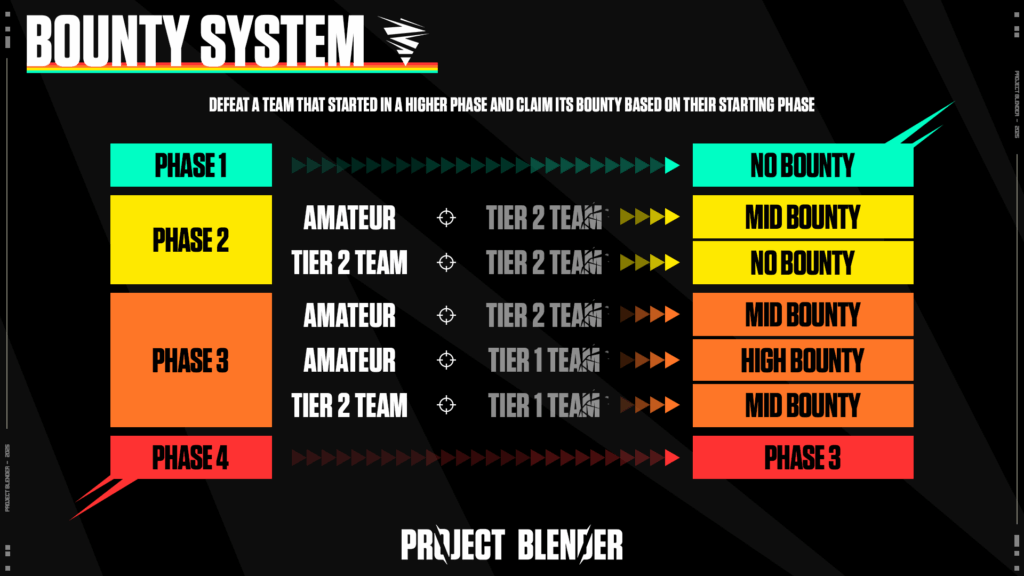
Project Blender offers a €75,000 (~£65,000) prize pool, which comprises a cash prize and bounties. Bounties reward amateur and tier-two teams for beating higher-tier opponents based on the tier difference.
Starting in Phase 2, amateur rosters can earn a ‘mid bounty’ against tier-two competitors. Phase 3 will also offer ‘high bounties’ for amateur versus tier-one teams. Moreover, tier-two squads will receive a mid bounty for defeating a tier-one opponent.
As of now, Project Blender has not revealed specific figures regarding the bounty sizes.
Who Can Compete at Project Blender?
All VALORANT players from the EMEA region (Europe, Middle East, North Africa) can participate in the competition as long as they have a latency of less than 80 ms on the Paris and Frankfurt servers. Registrations will open in September.
In addition to competitors, Project Blender is looking for on-air talent for its casting crew. Interested casters can apply via the dedicated online form.
All information and updates about the tournament can be found on the Project Blender website.