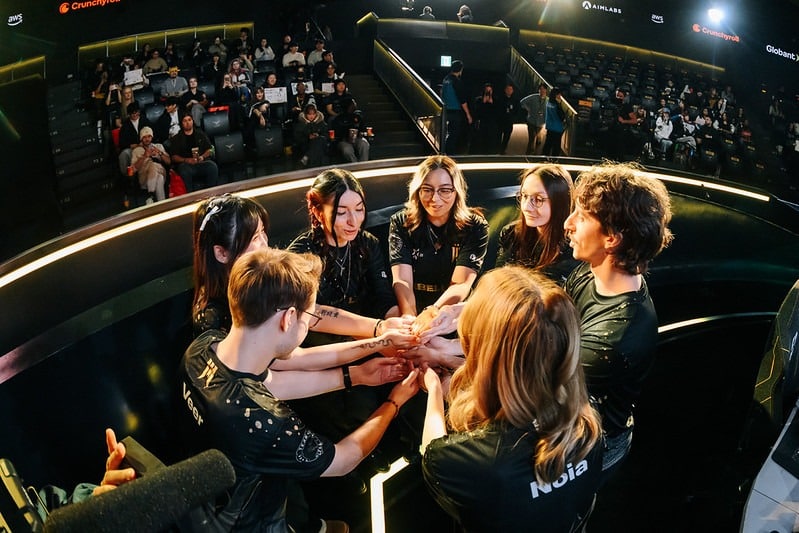
Women make up almost half of the world’s gaming population, yet they hold only about 5% of competitive and professional roles in esports. The gap becomes even more jarring at the upper echelons, when the highest-earning women in esports don’t even crack the top 600 all-time earners list.
While female-only tournaments have grown significantly, boasting combined prize pools of over $3 million, they still only represent a fraction of what the broader esports scene pays out. So what’s the reason behind this gap? Is it simply a difference in skill, or do opportunity, investment, and visibility also play a role?
In this article, we take a closer look at what recent studies and esports data can tell us about performance, prize money, and viewership – and whether skill alone can realistically explain the enormous gap between male and female esports players.
Women remain far behind in esports numbers
Let’s start with money, as it’s the most visible measure. As of Aug. 14, 2026, Esports Earnings data show that the top 40 highest-paid men have pulled in a combined $168.27 million in tournament winnings, compared with about $4.11 million for the comparable group of top female players.
That works out to roughly $4.21 million in prize money per male player versus about $100,188 per female player – a gap of more than 42 times. However, an especially interesting statistic can be found further down the rankings.
Canadian StarCraft II player Sasha ‘Scarlett’ Hostyn, the highest-earning woman with $472,111 in lifetime earnings, currently sits at #651 overall. Now, this ranking doesn’t make Scarlett’s career less impressive. What it instead highlights is just how concentrated the largest prize pools have been among male competitors.

Opportunities available to women in esports
The earnings gap makes even more sense after considering that female-only esports represent a much smaller share of the esports calendar.
In 2024, Esports Charts recorded more than 6,700 esports tournaments, but women-only events accounted for just 3% of the entire ecosystem. Only 15 esports titles hosted women’s tournaments at all, and in most of those titles, they represented just under 5% of the competitive calendar.
In our 2025 report on women in esports, we looked more closely at the three games with arguably the most established women’s scenes. Even there, the disparity was striking.
VALORANT was comfortably the strongest example: women-only competitions represented 23.9% of its tournaments and 13.8% of its total prize pool. In Mobile Legends: Bang Bang, those figures fell to 11.7% and 9.1%, while Counter-Strike accounted for just 5.3% of tournaments and 2.7% of prize money.
| Game | Tournaments reserved for women | Total prize pool awarded to women | Share of total watch time |
|---|---|---|---|
| VALORANT | 23.9% | 13.8% | 5.6% |
| Mobile Legends: Bang Bang | 11.7% | 9.1% | 1.3% |
| Counter-Strike | 5.3% | 2.7% | 0.2% |
Note: These statistics are derived from Esports Charts and reflect tournaments specifically reserved for women, rather than mixed-gender competitions.
The audience gap is even wider
The disparity becomes even more pronounced when we look at viewership.
Despite VALORANT having the most developed women’s esports scene, its women-only tournaments accounted for only 5.6% of total watch time in 2024. That number dropped to 1.3% for MLBB and only 0.2% for Counter-Strike. Across the entire women’s esports ecosystem, viewership fell by 26% that year.
This matters because prize money does not exist in isolation.
Larger audiences make tournaments more commercially valuable to publishers, sponsors, and organizers, thereby supporting more lucrative prize pools and more events. On the other hand, smaller audiences can leave women’s competitions fighting for investment even when competitive structures already exist.

Of course, tournament winnings aren’t the same as salaries, so these figures don’t necessarily prove that male and female players are being paid differently for doing the same job. Prize earnings are shaped by the games players compete in, the tournaments available to them, qualification systems, prize pools, and how long they remain at the top.
However, the numbers reveal something much broader than a simple earnings gap. Female players generally have fewer tournaments to enter, a smaller share of the available prize money, and substantially smaller audiences at those competitions.
That naturally raises a much harder question: can differences in player performance really explain disparities of this size?
Are women really that bad at esports?
A 2026 study published in Humanities and Social Sciences Communications looked at the relationship between gender, performance, viewership, and prize money in Counter-Strike.
The researchers compared player data from the ESL Impact League, an elite women-only Counter-Strike league, with that of a comparable men’s league. They used HLTV match records and Twitch viewership data across 40 tournaments and over 3,000 individual player performances.
One measure used by the researchers was kill-to-death ratio, or KD. The average male KD was 1.02, compared with 0.97 for females, reflecting a small but statistically meaningful difference in the dataset.
Importantly, male and female players competed in separate leagues against different opponents, so these averages do not indicate that men were simply “5% better” at Counter-Strike. This is because KD measures relative performance, not absolute skill, across entirely separate competitive structures.
What becomes more interesting, though, is what lies behind those performance numbers.
| Metric | Male players | Female players |
|---|---|---|
| Average prize money per tournament | $28,202 | $5,709 |
| Average match views | ~6.05 million | ~196,000 |
| Average kills per death | 1.02 KD | 0.97 KD |
The commercial gap is huge
After statistically accounting for performance, the researchers found that women’s matches received about 4.7 million fewer average views per match than men’s. Moreover, playing well didn’t pay off the same way for both groups: stronger performance translated into more views and more prize money for men far more reliably than it did for women.
This suggests that even when women perform well, their performance does not generate the same commercial reward as it does in the men’s ecosystem.
Imagine two players producing similarly impressive performances during a tournament. One plays in front of millions of viewers, while the other plays in front of a fraction of that audience. The first player is naturally more visible to fans, organizations, and sponsors, making their competition a more commercially valuable product.
That can create a self-reinforcing cycle: performance brings attention, attention creates opportunities, and those opportunities provide more chances to perform. As a result, the question begins to shift from whether there is a gender skill gap to whether women have the same foundation to develop and profit from skill in the first place.

What happens before an esports player goes pro?
A player cannot become a professional esports player if they never get far enough to compete for that spot.
This sounds obvious, but it changes the question. Instead of asking only why there aren’t more women at the top, it is worth asking what happens to players on the way there. Research on women in gaming repeatedly points to the role of the environment.
A 2021 study by Reach3 Insights and Lenovo surveyed 900 women gamers across the United States, China, and Germany. It found that 77% had experienced frustration related to their gender while gaming. The most commonly reported experiences included judgments about skill, gatekeeping, and patronizing comments.
Perhaps the most striking number is that 59% of respondents said they used a non-gendered or male identity while playing online to avoid conflict. Imagine spending hours practicing your aim, learning utility lineups, or reviewing VODs, only to decide that the safest way to play is to make sure your teammates don’t know you’re a woman.
Hostile gaming could be blocking the talent pipeline
Now, that doesn’t mean harassment directly causes women to quit esports. However, it shows that the experience of participating in gaming spaces can differ significantly by gender. And that distinction matters.
If someone becomes less willing to use voice chat, participate in competitive communities, or spend hours grinding ranked games due to a hostile or toxic esports environment, it’s reasonable to ask whether those changes could affect the pipeline long before anybody actually reaches the professional level.
By the time we compare professional players, we may already be looking at the survivors of two very different paths.

Can women-only esports tournaments help?
This is one reason women’s esports leagues exist in the first place.
VALORANT Game Changers and the now-defunct ESL Impact were not created simply because women cannot play against men. Instead, these circuits provide additional competitive pathways for female players to compete, build teams, gain experience, and become more visible to audiences and organizations.
Better still, there is some evidence that this approach can actually help.
A 2023 study by Nolla and colleagues found that novice women gamers had better outcomes in women-only tournaments than in mixed-gender ones. The women who competed in these events gave more accurate estimates of their own skill and reported greater task importance.
The researchers suggested that women-only tournaments could therefore help with recruitment and retention, while still existing alongside mixed-gender competition.
What happens when the pipeline runs out of money?
Creating a competitive pathway is one challenge, but making it financially sustainable is another. ESL Impact proved just how difficult that can be.
After three years of running a structured women’s Counter-Strike circuit, ESL announced that it would suspend the league, citing an unsustainable economic model. However, that was not because there were no audiences for women’s esports.
Esports Charts recorded a 7.9% decline in total watch time in 2025, while the number of women’s events fell by a much larger 52%. Despite there being considerably fewer tournaments, average concurrent viewership actually increased.

VALORANT Game Changers pulled in 6.3 million hours watched, around 45 times more than ESL Impact. Meanwhile, the MLBB women’s tournament at the 2023 SEA Games remains the single most-watched women’s esports event ever recorded, reaching 1.3 million peak viewers.
The problem, then, is not simply whether people will watch women’s esports. The more difficult question is whether those audiences can become large and consistent enough to support leagues, teams, players, and tournament organizers year after year.
That is especially important because once those competitions disappear, the consequences extend beyond the tournament itself. Fewer leagues mean fewer roster spots, fewer opportunities for upcoming players, and fewer chances for those players to become visible enough to reach the next level.
Conclusion
Overall, the research doesn’t give us a simple answer to whether women are inherently better or worse at esports.
The 2026 Counter-Strike study found a small but statistically significant difference in average KD. But because those players competed in separate leagues against different opposition, there are clear limits to what that KD difference can tell us about relative skill. What we can compare more clearly is the scale of the ecosystems surrounding those players.
In the study, men’s matches attracted roughly 31 times as many average views, while average tournament prize money was almost five times higher. Those differences remained substantial even after the researchers statistically accounted for player performance.
That still doesn’t prove gender explains every difference in esports, though. Experience, competition depth, game selection, tournament structures, audience size, and access to opportunities can all influence the numbers. But it makes one conclusion difficult to ignore: skill alone cannot explain a gap this large.
It’s not all about skill
For a player trying to reach the top, being “good” is only the beginning. They need tournaments to enter, teams willing to sign them, strong competition to improve against, audiences to watch, and organizations willing to keep investing.
Women-only leagues can help build that pathway, but they also need sufficient commercial support to survive. Ultimately, the question may not be whether women are good enough for esports. It may be whether enough of them are ever given the same opportunity to find out.
Editorial note: This article interprets peer-reviewed research for a general esports audience. Every effort has been made to represent the studies accurately, but the findings should be read within the limitations of the original research, including small samples, differing methods, and limited evidence.