TL;DR
- Dota 2 features eight ranks, ranging from Herald to Immortal, with most tiers subdivided into five stars and having distinct thresholds for progression.
- The rank system is built on Glicko and factors in both matchmaking rating (MMR) and Rank Confidence to verify a player’s skill level.
- MMR determines matchmaking and medal rank, increasing by about 25 points per win and decreasing by the same amount per loss, regardless of individual performance.
Dota 2 ranks are more than just a badge on your profile, but rather a reflection of countless hours of intense grinding. From the chaos of the trenches to the intensity of high-MMR lobbies, the ranked ladder is intentionally designed to separate casuals from diehard competitors.
In this guide, we’ll detail everything you need to know about the Dota 2 ranking system, including how MMR works and what it takes to climb out of the trenches.
Editor’s Note: Owen Harsono is an Immortal-ranked player, currently placed SEA #1770 on the regional leaderboards. His firsthand experience competing in high MMR brackets provides practical insight into how the ranking system works at every level.
What Are Dota 2 Ranks?
Dota 2 ranks are a representation of a player’s current skill level in ranked matchmaking.
Each rank is designed to place players of similar skill into the same ranked match, resulting in fairer and more balanced matchmaking.
For every ranked game you win, your rank gradually increases, though consecutive victories will pair you with increasingly tougher opponents. By contrast, losing ranked games will cause your rank to drop.
All rank tiers in Dota 2 are displayed as medals that are shown on your profile for everyone to see. You can think of these medals as a badge of honor – if you want people to respect you, you’ll want to climb the ranks and show them off.
How many ranks are in Dota 2?
Dota 2 has eight rank tiers, including Herald (the lowest), Guardian, Crusader, Archon, Legend, Ancient, Divine, and Immortal (the highest). These tiers cover a wide range of skill levels across the entire playerbase.
Except for the Immortal rank, all ranks are split into five stars or subdivisions, denoted by the Roman numerals I–V. You’ll need to progress through all the stars before you can progress to the next rank tier.
For example, once you hit Archon V, your next stop is Legend I. From there, you keep climbing through Legend II, III, and so on. Think of each star as a little checkpoint on your way up.
Complete list of Dota 2 ranks
Here’s a list of all Dota 2 ranks, ordered from lowest to highest, including their tier divisions:
- Herald I–V
- Guardian I–V
- Crusader I–V
- Archon I–V
- Legend I–V
- Ancient I–V
- Divine I–V
- Immortal
Most beginners are in the lower ranks, like Herald, Guardian, and Crusader. The majority of the player base hangs around Archon and Legend. Players in Ancient to Divine are generally more experienced and skilled, while Immortal is reserved for the top-tier players.

Immortal Rank and Leaderboards Explained
The Immortal bracket is the highest rank in Dota 2 and does not follow the standard five-star progression. Once you hit Immortal, your MMR will continue to increase without an upper limit.
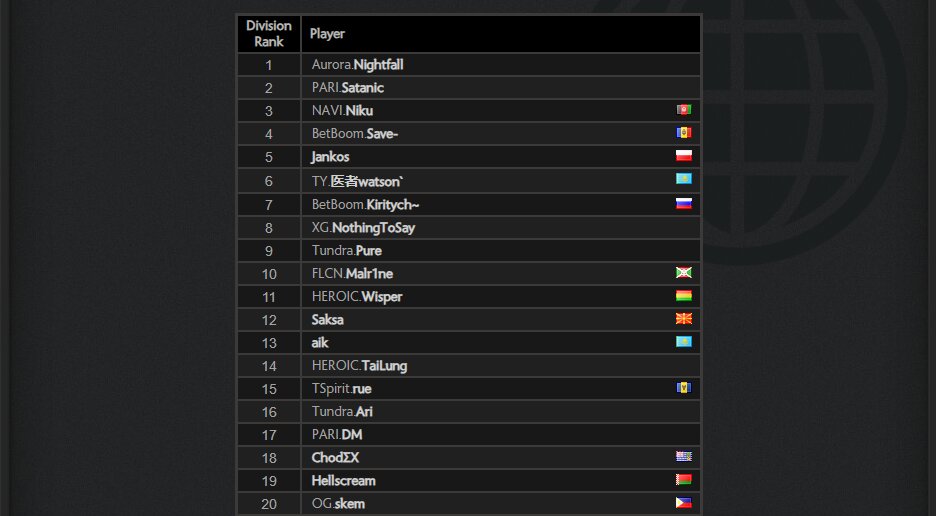
To reflect this, Immortal operates on a live regional leaderboard system to differentiate skill levels, based entirely on MMR.
Players receive numbered placements, with special medal distinctions awarded to those in the Top 5,000, Top 100, Top 10, and the #1 spot in their region. Any players outside these thresholds remain unranked and without a leaderboard number.
All Immortal players with numbered placement are also featured on Valve’s official Dota 2 leaderboard.
What is the difference between MMR and rank in Dota 2?
In Dota 2, MMR (or “matchmaking rating”) is a numerical representation of your skill level in ranked games, whereas your rank or medal is merely a visual representation of that MMR.
Importantly, MMR is only visible to you, increasing with every ranked game you win and decreasing when you lose — it’s also the primary factor used to balance matchmaking. Your rank or medal is displayed publicly on your profile – even to players who aren’t on your friend list.
Dota 2 MMR system explained
Matchmaking progression in Dota 2 is primarily centered around MMR.
Think of it as a friend you’ll be checking in with every now and then throughout your ranked journey. At its core, MMR tells the matchmaking system in which skill bracket you belong and which players you should be paired with.
Every Dota 2 ranked match you play affects your MMR. If you win, it goes up; if you lose, it goes down – the idea sounds pretty simple, but there’s a bit more to it, which we’ll explain below.

How MMR is gained and lost
When you load into a ranked game in Dota 2, you’re instantly putting your MMR on the line. On average, each ranked match will change your MMR by roughly 25 points.
However, the amount of MMR you gain or lose isn’t affected by how well you personally performed in the specific game. You could go 34–3 K-D and carry your team to victory, or win the game with a 1–12 K-D, and your MMR change would still be the same as everyone else.
Everyone on your team will get the same number of points, and the amount gained or lost between both teams is also equal. For example, if you win +24 MMR, your enemies will drop by 24 MMR. You’re basically stealing each other’s MMR points.
However, all of this assumes your Rank Confidence in the Glicko system is stable. Early on, or if your rank is still uncertain, MMR gains and losses can behave a bit differently, which we’ll explain next.
Glicko and Rank Confidence
Besides your MMR, every player in Dota 2 is assigned a Rank Confidence — a percentage that tracks how confident the system is that your MMR accurately reflects your skill level.
It’s powered by the Glicko system and helps the matchmaker place you into more balanced games. New players always start with 0% Rank Confidence. As you play more ranked games, that percentage increases, and the system becomes more confident in your rating.
When your confidence is low, your MMR gains and losses can fluctuate more than usual. This allows the system to move you closer to your true rank faster, even if that means aggressively pushing you up or down the ladder. It is the only situation where you’ll gain or lose more MMR than everyone else in the match.
Note: You are considered calibrated once your Rank Confidence reaches 30% or higher. If it drops below 30%, your medal will appear as uncalibrated, and your MMR will be hidden until you play enough games to raise your confidence again.

If your Rank Confidence drops below 30%, you will lose your rank medal and enter calibration / Image credit: Chadley Kemp for Esports Insider
Role-Based MMR explained
In the past, Dota 2 had separate role-based MMRs for core and support roles.
Core MMR tracked how well you performed when playing carry, mid, or offlane, while Support MMR reflected your skill when playing either hard support or soft support. This meant players could be a Divine core player, but only a Legend support.
However, Valve removed the role-based MMR system on March 2, 2020. Since Dota 2 patch 7.33 (i.e., the “New Frontiers” update), everyone has a single matchmaking rating, which is affected no matter what role you play.
Dota 2 MMR threshold for each rank
At this point, you might be thinking, “How many MMR points are needed for each Dota 2 rank?” To make things easier to visualize, here is a breakdown of the MMR changes for every medal tier:
| Dota 2 rank | MMR range |
|---|---|
| Herald 1 | 1–154 |
| Herald 2 | 154–308 |
| Herald 3 | 308–462 |
| Herald 4 | 462–616 |
| Herald 5 | 616–769 |
| Guardian 1 | 770–924 |
| Guardian 2 | 924–1078 |
| Guardian 3 | 1078–1232 |
| Guardian 4 | 1232–1386 |
| Guardian 5 | 1386–1540 |
| Crusader 1 | 1540–1694 |
| Crusader 2 | 1694–1848 |
| Crusader 3 | 1848–2002 |
| Crusader 4 | 2002–2156 |
| Crusader 5 | 2156–2310 |
| Archon 1 | 2310–2464 |
| Archon 2 | 2464–2618 |
| Archon 3 | 2618–2772 |
| Archon 4 | 2772–2926 |
| Archon 5 | 2926–3080 |
| Legend 1 | 3080–3234 |
| Legend 2 | 3234–3388 |
| Legend 3 | 3388–3542 |
| Legend 4 | 3542–3696 |
| Legend 5 | 3696–3850 |
| Ancient 1 | 3850–4004 |
| Ancient 2 | 4004–4158 |
| Ancient 3 | 4158–4312 |
| Ancient 4 | 4312–4466 |
| Ancient 5 | 4466–4620 |
| Divine 1 | 4620–4820 |
| Divine 2 | 4820–5020 |
| Divine 3 | 5020–5220 |
| Divine 4 | 5220–5420 |
| Divine 5 | 5420–5620 |
| Immortal | 5620+ |
Note: Each sub-division, or star, up to Ancient is worth roughly 154 MMR. That means each medal adds up to about 770 MMR. Once you hit Divine, things will slow down a little, as each star is only worth 200 MMR. To reach Immortal, you’ll have to pass through 5,620 MMR.
Dota 2 rank distribution at every tier
Seeing the numbers on each rank doesn’t necessarily tell the full story. If you want to get a better sense of where Dota 2 ranked players actually sit, here’s a look at how Dota 2 ranks are distributed:
Note: Rank distribution data is sourced from OpenDota, based on aggregated statistics from approximately 7.8 million players. Data retrieved on March 3, 2026.
What is considered low, average, and high ranks in Dota 2?
Generally speaking, Herald, Guardian, and Crusader are considered the lower ranks in Dota 2. You’ll usually come across new players or those struggling to get used to the game’s mechanics in these brackets.
Most Dota 2 players sit in Archon and Legend brackets. Players in these ranks have honed game mechanics or just play the game for fun.
The Ancient bracket comprises the top 20th percentile of all Dota 2 players — these players have mastered multiple heroes, have solid game sense, and have a firm grasp of advanced mechanics. You can call yourself a decent player if you’re somewhere in Ancient or Divine.
Immortal is reserved for serious, highly skilled players and professionals. Remember that there’s still a huge gap between a fresh Immortal and an Immortal in the top 200, but reaching this rank pretty much clears you away from the vast majority of players.
Does Dota 2 have rank decay?
Yes, rank decay does exist in Dota 2 — but it’s a little different from what most people think when they hear the term.
If you stop playing for a while, your MMR doesn’t directly decrease. Instead, your Rank Confidence gradually drops. If confidence falls below 30%, your account becomes uncalibrated, hiding your MMR until you play enough games to bring it back above 30%.
Once your confidence is back, your MMR will be revealed, and depending on how well you performed in those matches, it could go up or down. So, it doesn’t strictly “decay” in the sense of losing points.
Speaking from experience, you usually won’t drift too far from where you were before the break – unless your rank confidence drops well below 5%, which would mean you haven’t played for years.
How to climb the Dota 2 ranks
Considering that you only gain roughly 25 MMR per match, it can feel quite discouraging to see how slow progress is, especially if you’re aiming to reach Immortal. However, climbing the ranks in Dota 2 is a marathon, not a sprint.
Here are five of our best tips to help you get there.
Stick to one role
Some people try to be a jack of all trades and master every role, but in reality, that will only slow down your progress.
Most Dota 2 pro players stick to one role throughout their entire careers. If your goal is to consistently climb up the ranks, adopting that same focused approach will reduce unnecessary variance in ranked games.
Play a maximum of three meta heroes
Along the same lines as mastering one of the five roles in Dota 2, you should focus on playing a maximum of three heroes at a time.
This focus helps you master them and understand their limits. It also gives you an edge if you pick heroes that are strong in the current meta. Picking meta heroes pretty much gives you a head start before the game even begins, just because your hero is naturally stronger.
Stay positive and don’t flame your team
Dota 2 can be extremely frustrating at times – we all know that. But flaming your teammates is basically a fast track pass to a quick loss.
When you start arguing, you lose focus on the game. Even more damning, if your teammate flames you back, your team now has two players who aren’t paying attention. Focus on playing until the Ancient drops, and save any bickering for the post-game chat.
Improve your map awareness
One thing that stays constant in every role is map awareness. Make it a habit to check your Dota 2 minimap every few seconds.
Good map awareness doesn’t just help you avoid unnecessary deaths, but lets you make callouts and alert your team, potentially saving them from incoming ganks too.
Avoid chain queuing
This is a personal tip, and one that I struggle with too. When you’re tilted or not in the right headspace, you become vulnerable to chain queuing.
Playing while you’re tilted usually just makes you play worse, and it can spiral out of control. Before you know it, you check your page and see eight losses in a row – and it’s already too late. Take a breather after tough losses before queuing again.

FAQs
What are Dota 2 ranks?
Dota 2 ranks are a visual representation of your current skill level in ranked matchmaking. There are eight tiers, ranging from the lowest Herald to the highest Immortal.
How does the Dota 2 ranking system work?
Your rank is determined by your matchmaking rating (or “MMR”), a numerical value that reflects your true skill level. This number fluctuates after each ranked match, increasing with wins and decreasing with losses.
What is the highest rank in Dota 2?
The highest rank in Dota 2 is Immortal. It operates on a live regional leaderboard system based entirely on MMR.
Can you lose your rank in Dota 2?
Not exactly. You don’t technically “lose” your rank by going inactive. However, your MMR might be hidden until you play enough matches to regain Rank Confidence.
Does rank reset every season?
No, your MMR does not reset. However, you can activate MMR recalibration to reset your rank. This feature has a 365-day cooldown.
REFERENCES
- Player 309247031Overview (DOTABUFF)
- World Leaderboards (Dota 2)
- The New Frontiers Update – Gameplay Update 7.33 (Dota 2)
- Rank Tiers (OpenDota)