TL;DR
- Bankroll management enables you to stay in control of your sports betting.
- Setting your betting units at 1% to 5% of your bankroll is a fundamental principle of smart bankroll management.
- Regular record-keeping and monthly reviews of betting expenses are good habits to keep when managing your sports betting bankroll.
Experienced gamblers understand the importance of bankroll management in sports betting. It adds discipline to your gambling, helps you to set goals, and can generate smart staking habits for your regular sports betting.
In this guide, we’ll tell you how to lay the foundations for sustainable sports betting bankroll management.
What is a bankroll and why does it matter?
Your bankroll is the money you set aside specifically for wagering on your chosen sports events, leagues, and players. It is the key to your sports betting money management.
We highly recommend that you keep your funds for gambling separate from the rest of your personal money. This will allow you to practice sensible bankroll management in sports betting.
Keeping your betting money in a separate account from your disposable income means you can track how much you win or lose without it affecting your personal expenses. Bankroll management in sports betting matters because it protects you from losing track of how much you are wagering, and potentially causing you financial hardship.
Managing your sports betting bankroll will help you gamble within your means and with funds that you can afford to lose. You should always gamble responsibly and ensure that betting on sports is an enjoyable leisure activity, rather than a pursuit that could lead to a dangerous and costly addiction.
Determine your starting bankroll
The first step in bankroll management in sports betting is to decide exactly how large your initial bankroll is going to be.
There are several factors to consider when making this decision:
Your financial situation
Only you can determine how much you can comfortably afford to spend on wagering.
Your betting frequency
How often do you bet on sports? Do you like a wager every day, or is it something you enjoy only when watching big games on the weekend? Adjust your bankroll accordingly if you’re not a frequent bettor.
Your risk tolerance
People have different attitudes to risk; some bettors enjoy small stakes on short-odds point spreads, while others might try to land high-stakes parlays.
Stay disciplined, and do not use money that you have already allocated towards expenses such as rent, household bills, savings, or debt payments. You should keep your bankroll completely separate from your personal account, which is where you store your household and disposable income. If you’re not doing this, it can make it difficult to track what money is being withdrawn from your personal account.
So, how much should your initial bankroll be? Only you can decide that. However, if you have $100 to spare, for instance, start with that; then the next thing to determine is your betting unit size.
Sports betting unit size explained: The foundation of bankroll discipline
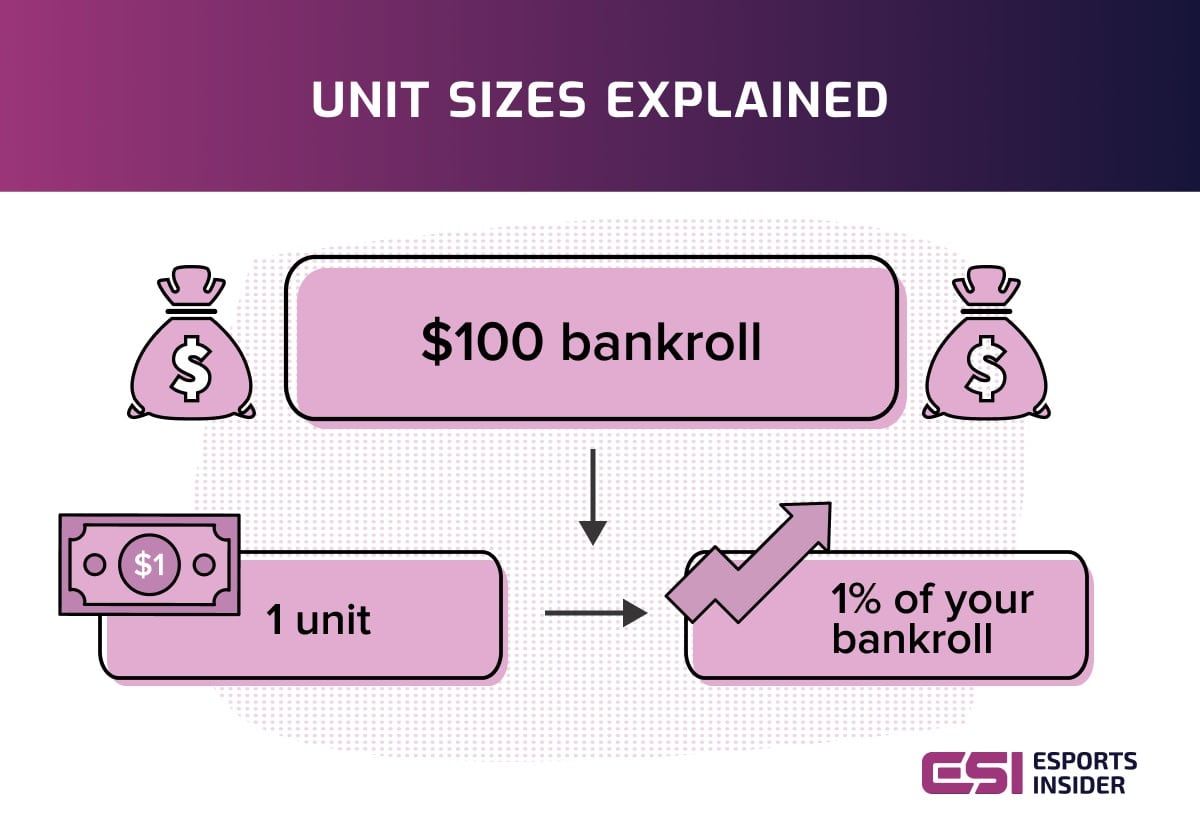
A betting unit is a fixed amount of money that you are willing to wager on each and every bet you make. Set your betting unit as soon as you determine your betting bankroll.
We recommend that your betting unit be between 1% and 5% of your bankroll. On an initial bankroll of $100, that means you will be staking between $1 and $5 for every bet you place.
Sticking with a fixed stake ensures you stay in control, in contrast to letting emotions take over, possibly causing you to wager more than you initially intended when you encounter a winning or losing run.
There aren’t ever guaranteed wins in gambling, and sports betting is no different, so you should ultimately choose your starting bankroll and unit size depending on how much money you can afford to lose. Gambling should be an enjoyable experience, and not one where you actively look to chase a potential profit.
Manage your profits to grow your bankroll
Every gambler knows that the house always wins. However, with good bankroll management in sports betting, you can increase your chances of making a profit, or, at least, making your funds last for as long as possible.
One key element of sports betting money management relates to your actions after you receive a payout. It can be tempting, when your bankroll has had a sudden boost, to increase the size of your bets immediately.
Of course, it’s enjoyable to be wagering using what still feels like the sportsbook’s money. However, it’s better to think of it as a reinvestment in your growing bankroll. It’s important to be disciplined about withdrawals, too. If you are fortunate enough to see a profit, we suggest following the 50/50 rule.
Take half of the profit out of your bankroll and put it in your personal account, and reinvest half of the winnings in your bankroll.
So, if you have a $100 win, take $50 as pure profit and reinvest $50 in the bankroll.
When and how to adjust your stakes
It’s not just after a big win that you need to practise good bankroll management in sports betting. You should review your results regularly and decide whether or not it’s time to increase or decrease your unit size.
Check your results after a specific time – maybe a month, or a set number of wagers. If your bankroll is growing, you may be able to raise your basic stake.
So, if you started with a bankroll of $100 and your unit size was $2, when your bankroll grows to $150, you may decide to up your normal wager to $3.
However, the stakes should only be raised if you consistently show winnings. If you’re lacking consistency or losing more than you win, you shouldn’t increase the stakes, as that isn’t sensible bankroll management and can have significant financial consequences.
📊 It’s essential, though, to do this gradually and after a cold-eyed review of your recent fortunes. Effective sports betting money management is rooted in prudent adjustments rather than a sudden and premature jump in your stakes.
Understanding ROI in sports betting
Understanding the meaning of return on investment (ROI) is crucial for effective bankroll management in sports betting. If you track your return on investment through the various staking plans you have in place, you can measure the potential success you’re having, or alternatively, the losses you could be mounting up.
The calculation of working out what your return on investment is as follows:
- Net profit divided by total amount wagered x 100%
Your net profit is the total returns, which includes your winnings, as well as the stake wagered, minus the total amount wagered from losing bets. Whereas the total amount wagered is all the money that you have wagered.
ROI is important for bettors for many reasons, including strategic evaluation and a long-term view, which involves comparing potential short-term luck and variance to an actual strategy.
Build long-term sustainability for your betting bankroll
Another recommended strategy to ensure good bankroll management is to keep a record of every bet you place. Not only will this help you to follow the fluctuating size of your bankroll, but it will also give you valuable insights into your wagering.
Look back over your recent wagers and you’ll be able to see your strengths and weaknesses. Are there particular types of bets that bring you more success than others? Are there others where your wins are so rare that you should probably stop placing them?
Keeping a record will also enable you to see the average odds of your winning bets, as well as your overall return on investment.
You may use a spreadsheet to keep track of all your sports bets. Alternatively, many online betting sites have useful tools to help you manage your betting bankroll. Several platforms have history logs that allow you to track your deposits and withdrawals as well as check your win/loss record over recent weeks and months.
Effective sports betting money management is essential for responsible gambling. Gambling on sports is supposed to be fun and entertaining. You decide how much you can afford to lose, enjoy the experience of watching a game you have invested in, and it’s a bonus if you get a payout.
There may come a time, however, when you realize you are gambling too heavily, or too frequently, and need to step away. Once you feel that you’re betting compulsively or needing to win, it may be time to take a break to assess your bankroll and overall well-being.
FAQs
What does bankroll management mean?
Bankroll management in sports betting is the process by which you keep a close check on your funds for wagering and track your wins and losses. We strongly recommend practicing effective bankroll management so that you know exactly how much you are investing in your sports betting.
How much should a beginner bettor wager on an initial stake?
That depends on the beginner. However, as a rule, you should start with small stakes, such as just 1% of your bankroll. That means wagering a dollar at a time if you start with a bankroll of $100. As you become more comfortable, you can gradually increase your stake.
Should I change my bet size after a big win?
Some experts claim you should follow a hot streak and ramp up your stakes if you win. Others urge caution and say you should cut your bets down to preserve your profits. Whichever camp you fall into, make the adjustment small and gradual.
What is a good bankroll for sports betting?
A good bankroll to start with for sports betting is with funds you can afford to lose, as there aren’t ever guaranteed wins in gambling. Some bettors prefer to start with a bankroll of $100, and then use a single unit as 1% of their bankroll.
Is a unit 1% of your bankroll?
Each bettor will have their own preference as to what a unit is when compared to their bankroll. However, it’s commonly known that a unit is 1% or 2% of your bankroll, as this can protect your bankroll in the long term.