TL;DR
- There are 10 ranked tiers currently in League of Legends, with Iron being the lowest rank and Challenger being the highest.
- Each tier between Iron and Diamond has four divisions, which are sublevels within that rank.
- Divisions do not exist in the Master, Grandmaster and Challenger tiers.
- Once players reach Diamond tier, they will be subject to rank decay if they do not play the game for extended periods.
League of Legends is an esports titan, and as one of the most popular online games in the world, its heavily populated competitive mode reflects this. Millions of players log in every day to grind their way to the next rank, and it has proved to be the core of the LoL experience.
If you want to join in, you will need to know more about the League of Legends ranks, how the competitive system works, and the strategies you can take to improve. We’ll go over all of it, and cover the LoL rank distribution system, the various tiers, and whether your rank decays with inactivity.
LoL ranks and tiers explained
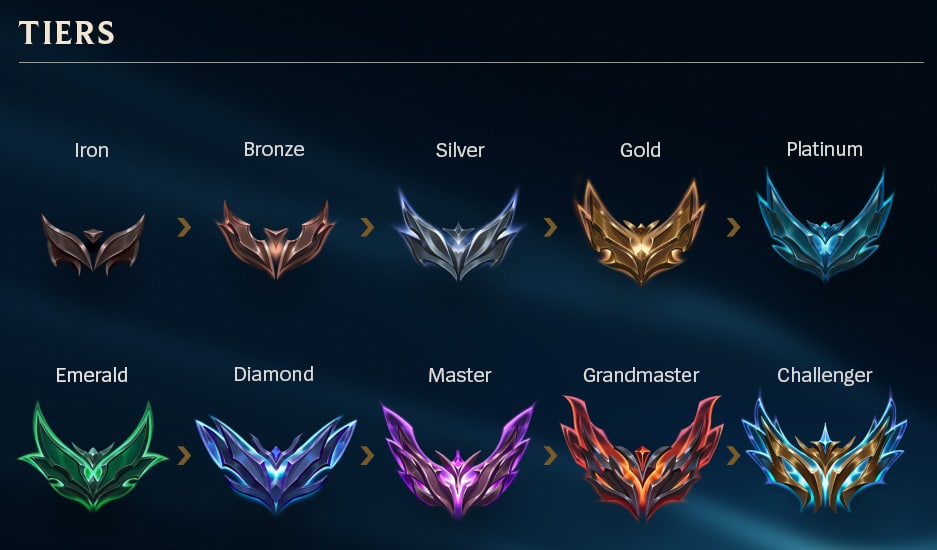
At the time of writing (January 2026), the League of Legends ranking system is made up of 10 distinct tiers. The League of Legends tier list is as follows, in ascending order:
- Iron
- Bronze
- Silver
- Gold
- Platinum
- Emerald
- Diamond
- Master
- Grandmaster
- Challenger
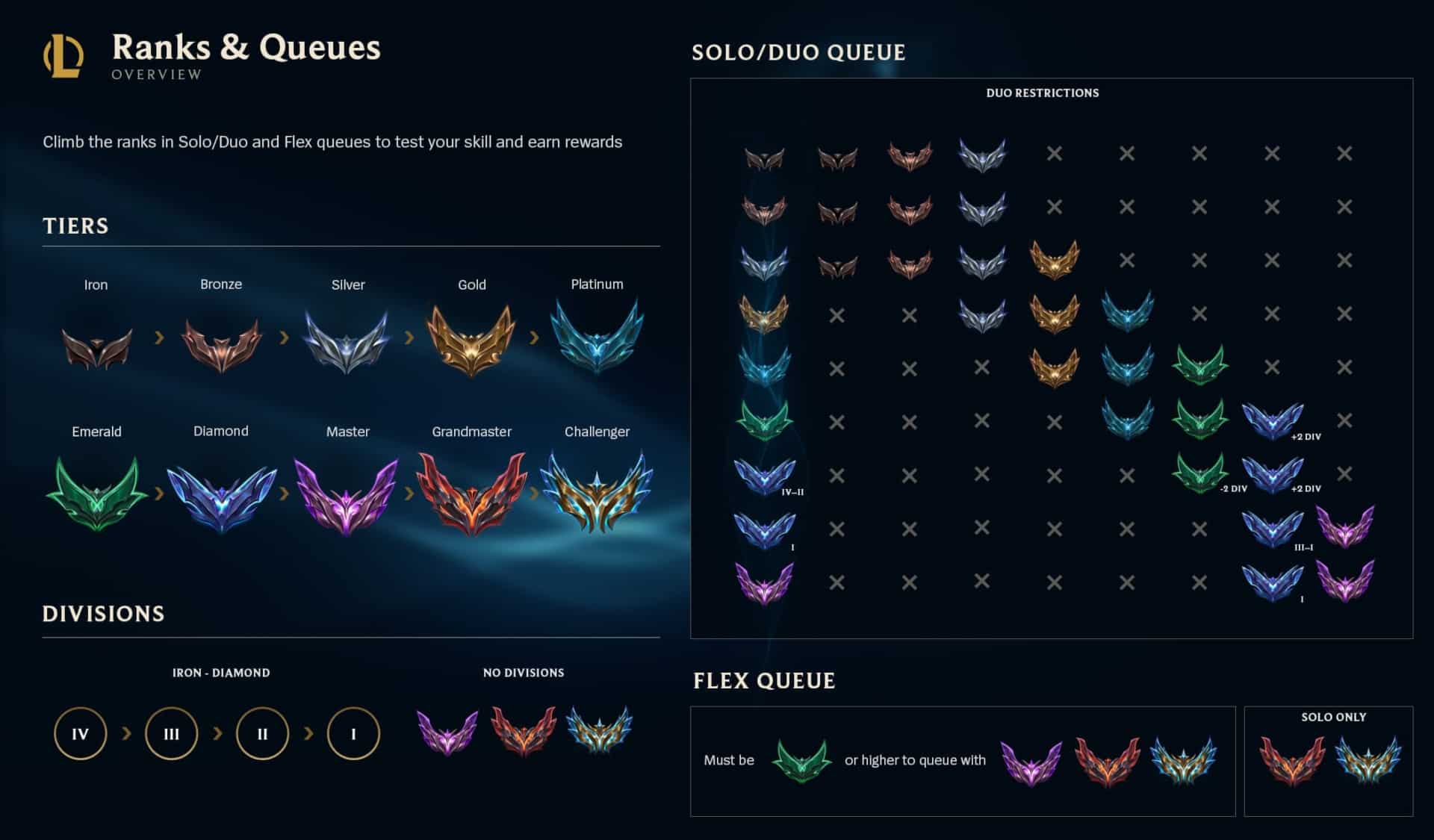
The Iron, Bronze, Silver, Gold, Platinum, Emerald, and Diamond tiers are all divided into four tiers. These divisions are labelled with Roman numerals, with I (one) being the highest and IV (four) being the lowest. Above Diamond stand the Master, Grandmaster, and Challenger tiers, which do not have divisions. These top ranks have special rules to suit the higher stakes nature of high-level games.
Competitive is split into two queues: Solo/Duo and Flex. These modes are kept separate, which also means that there are separate ranks for each.
How does the LoL ranking system work?
- League Points (LP) are won and lost during comp games
- A player’s MMR dictates the amount of LP they win/lose
- The win and loss rate changes depending on the tier of the player
- Players can only start playing ranked competitive mode once they reach level 30.
In the LoL ranking system, players make their way through divisions by obtaining League Points. When playing competitive games, players earn League Points, also known as LP. LP is earned when you win comp games, and lost when you are defeated.
The LP won or lost is directly connected to a player’s MMR (Match Making Rating). MMR is a hidden rating relative to the level of a player’s rank. For instance, if a player’s MMR is high relative to their rank, they will lose fewer LP with a loss and gain more on a win. MMR also affects who you end up with and against in comp games, meaning that matches should be as even as possible in terms of skill level.
LP won and lost is also affected by the tier a player is in. For instance, those in the metal ranks (Iron, Bronze, Silver, Gold, and Platinum) have a baseline LP loss and gain of 25. Those in Emerald or above tend to have a baseline loss and gain of 20 LP.
Before you can start adding LP to your name and begin your ranked journey, you have to reach level 30 first. If you aren’t there yet, but want to play League of Legends ranked mode, keep playing Quickplay or Draft.
Rank distribution in LoL
With its seasons making adjustments to champions, rank distribution in League of Legends tends to fluctuate. It’s an ever-changing and ever-evolving game. Still, according to League of Graphs, Silver, Gold, and Bronze are the three most populated tiers, in that order, as of January 2026.
The League of Legends rank order of the three least populated tiers are Challenger, Grandmaster, and Master, which are also the three highest ranks. Below are tables for rank distribution for both Solo/Duo and Flex queue.
Solo/Duo Queue
| Tier | Player percentage |
|---|---|
| Challenger | 0.046% |
| Grandmaster | 0.1% |
| Master | 0.78% |
| Diamond | 3% |
| Emerald | 7.9% |
| Platinum | 16% |
| Gold | 24% |
| Silver | 26% |
| Bronze | 20% |
| Iron | 1.8% |
Draft Ranked Flex
| Tier | Player percentage |
|---|---|
| Challenger | 0.018% |
| Grandmaster | 0.043% |
| Master | 0.31% |
| Diamond | 4.3% |
| Emerald | 13% |
| Platinum | 19% |
| Gold | 22% |
| Silver | 26% |
| Bronze | 13% |
| Iron | 1.5% |
As mentioned, this is subject to constant change due to the nature of LoL as an online, live service game. For now, Gold, Silver, and Bronze are where most Solo/Duo players sit, while Flex players are in Gold and Silver.
How to rank up faster in LoL

- Learning the game mechanics and different roles is vital
- Familiarising yourself with a handful of champions and their skill kits will provide you with a good baseline of knowledge
- Consider the meta, but opt for champions you feel comfortable with and are happy playing as
- Focus on some of the core elements of gameplay, such as positioning, last-hitting, and team communication.
- You can then start getting into specifics with your chosen hero and role, such as skillshot accuracy for bottom laners and snipers.
With any online, competitive game, there’s no shortcut to ranking up fast in League of Legends. It requires practice, skill, and a willingness to learn. It will take more than a single night to become a master, and improving will take time, especially with the different roles, giant champion roster, and builds. You need to learn the basics before you can rank up quickly.
Once you have some experience under your belt, pick a handful of champions – two or three, maybe four if you think you can manage that many – and start playing with them frequently to get used to their skill kits and how they can be played in a match. Make sure you pick a champion that resonates with you and you enjoy playing with. Considering the current meta of the game is important if you want to reach the higher League of Legends rank tiers, but don’t let this mindset lock you into a hero that you can’t get to grips with. Consider the meta, but opt for heroes that you feel comfortable with and are happy playing as. League of Legends tier lists can be useful if you are unsure of who to pick, as they rank the best heroes for each role in the game’s current state.
Focus on some of the core elements of gameplay, such as positioning, last-hitting (getting the final hit in on a minion) and team communication. These fundamentals are gameplay elements that every player must be aware of, no matter what lane they are in or what position they are playing. When you’ve got the basics down, you can start getting into specifics with your chosen hero and role, such as skillshot accuracy for bottom laners and snipers or managing buffs for allies as a support.
If possible, team up with people you know and can trust. Ideally, they would be friends, but at the very least, they should be reliable players you can work with. If communicating with your team on a mic isn’t possible, use the ping communication and team chat instead. Communication is vital, and while there is a lot to master mechanically in League of Legends, being able to convey strategies is vital to making a team function. Pair this with strong foundations and a good understanding of your chosen champions, and you’ll start ranking up before you know it.
Rank decay in LoL
Rank decay does exist, but players don’t have to worry about it until they reach higher tiers in the competitive League of Legends ratings. Only those in Diamond tier and above have to deal with rank decay.
Once you are within these tiers, you will need to put in more time and effort to ensure that you stay at the top. If you go too long without playing, you will begin to lose some LP every day. However, there is a system in place that gives players leeway when it comes to playing daily. That system is banked days.
When you first enter Diamond rank, you will automatically receive a number of banked days, which are basically a time buffer of sorts set up before your rank starts to decay. Banked days are added with each ranked game played, and days when you don’t play LoL will count as a banked day.
When your reserve of banked days is depleted, you will start to lose your LP. The amount of banked days you can earn with each match and the amount of LP you lose when your rank begins to decay will vary depending on the tier you are currently in. Take a look at the table below for all the info.
| Tier | Days banked with each match | Maximum amount of banked days | Days before decay | LP lost when decay begins |
|---|---|---|---|---|
| Diamond | 7 | 28 | 28 | 50 |
| Master | 1 | 14 | 14 | 75 |
| Grandmaster | 1 | 14 | 14 | 75 |
| Challenger | 1 | 14 | 14 | 75 |
Players who end up at 0 LP because of decay will fall into the previous division. If you’re already in the lowest division in your tier, you will be placed into the highest division of the previous tier. For instance, if you are in Master IV and lose enough LP, you will be demoted to Diamond I.
Conclusion
League of Legends ranks aren’t easy to climb, but understanding how they work is a strong first step. Once you know how they work and have enough games under your belt to start the climb, remember to keep an open mind and keep learning. The road from Iron to Challenger is a long one, but remaining adaptable will make it feel possible.
Playing with friends and communicating well will make the grind as enjoyable as possible, and having fun should remain the aim. You will likely play better if you’re feeling good about your game, so if some losses are getting to you, cool off before it snowballs into further defeats.
FAQs
What is the highest rank in League of Legends?
The highest League of Legends rank is currently the Challenger rank.
How many ranks are there in League of Legends?
There are 10 League of Legends ranks as of January 2026.
What are divisions in League of Legends ranks?
Divisions are sublevels within the rank tiers in League of Legends. Tiers Iron through to Diamond are each split into four tiers, with IV being the lowest and I being the highest. For example, Gold IV is the lowest division within the Gold tier, but as you play and win games, you will make your way through the divisions until you reach Gold I. Once you have reached the maximum level within Gold I, you’ll start the process again in the following tier (which would be Platinum IV with this example). Losing games can also lead to demotion to previous divisions and tiers. There are no divisions for the top three tiers, which are Master, Grandmaster and Challenger.
Do League of Legends ranks reset each season?
In 2025, it was announced that League of Legends would have one major rank reset every year in January. This is when the full, soft reset will occur for all players. There will still be multiple seasons throughout the year (also known as splits), but there won’t be an accompanying rank reset with every season.
REFERENCES
- League Points (League of Legends Fandom)
- MMR, Rank, and LP (Riot Games)
- Rank distribution (League of Graphs)
- Placements, Promotions, Series, Demotions, and Decay (Riot Games)
- /dev: Ranked Update Season One 2025 (League of Legends)
- Ranked Years, Seasons, and End-of-Season Rewards (Riot Games)