
TL;DR
- There are five rune paths in League of Legends: Precision, Domination, Sorcery, Resolve, and Inspiration.
- Runes offer passive effects tailored to your champion’s strengths and role.
- Each rune page consists of one primary path (with a keystone) and a secondary path with two bonus runes.
- Choosing the right runes can help you win lane, secure more kills, and scale more efficiently as the game goes on.
- Riot provides default rune pages, but creating custom setups unlocks deeper optimisation.
- Sites like OP.GG or U.GG can help guide rune choices based on the current meta and player win rates.
League of Legends has complexity that extends beyond its mechanical skill. There are item builds, champion picks, and team comps to take into account, but LoL runes play an important role in a winning team, sometimes before you even land in Summoner’s Rift.
The Runes in League of Legends offer vital passive enhancements that can add new abilities or buffs to a champion, shaping the way a match will be played, from improving sustain to stacking burst damage. These runes can be used to amplify your champion’s strength or paper over their weaknesses, shaping them for a specific playstyle, but what do each of the LoL runes do?
Our League of Legends runes guide for 2026 will break down everything you need to know about LoL runes and how to use them.
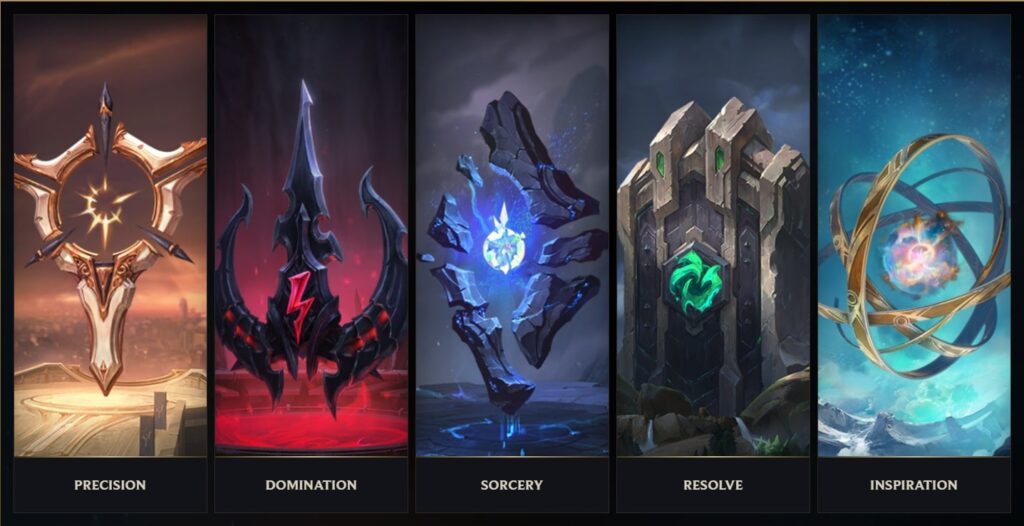
LoL runes explained
League of Legends runes essentially act as customisable loadouts players choose before a match begins, as opposed to items, which shape a playstyle during a match. Runes enhance a champion’s stats, abilities, and approach. The easiest way to think of them is as passive perks that give you an edge and tailor a champion to how you want to play.
There are five main rune paths:
- Precision (sustained damage and attack speed)
- Domination (burst damage and assassination)
- Sorcery (poke, utility, and ability power)
- Resolve (durability and crowd control)
- Inspiration (creative tools, utility, and bonuses)
These rune paths include a keystone rune, the most powerful perk, along with a bunch of minor runes that give you smaller bonuses. Before the game starts, you choose one primary and secondary path, as well as stat shards to further refine your build.
In short, Runes shape how your champion performs, and building the right rune page is key to winning matchups and scaling effectively.
The five rune paths
Rune paths in LoL are designed to support specific playstyles, enhancing a chosen champion’s strength. Each path consists of keystone runes and three slots (primary, secondary, and tertiary). Here is the breakdown of the five major LoL rune paths.
Precision
The Precision rune path is typically favoured by ADCs or champions in the fighter class who revolve around sustained damage and consistently trading. This path improves attack speed, auto-attack damage output, and survivability during longer fights.
- Keystone runes: Press the Attack, Lethal Tempo, Fleet Footwork, Conqueror
- Slot 1 runes: Presence of Mind, Triumph, Absorb Life
- Slot 2 runes: Legend: Alacrity, Legend: Bloodline, Legend: Haste
- Slot 3 runes: Coup de Grace, Cut Down, Last Stand
Domination
The Domination rune path is for those who are looking for burst damage and aggression, usually suited for mages and assassins, typically in Mid or the Jungle. These runes are ideal for those wanting to secure kills quickly and roam the map.
- Keystone runes: Electrocute, Dark Harvest, Hail of Blades
- Slot 1 runes: Cheap Shot, Taste of Blood, Sudden Impact
- Slot 2 runes: Sixth Sense, Grisly Mementos, Deep Ward
- Slot 3 runes: Treasure Hunter, Relentless Hunter, Ultimate Hunter
Sorcery
Those choosing the Sorcery rune path pick it for its enhancements to a champion’s poke, burst damage, or scale with their ability power stat. As a result, it’s the natural choice for mages, along with supports and poke-heavy champions.
- Keystone runes: Summon Aery, Arcane Comet, Phase Rush
- Slot 1 runes: Axom Arcanist, Manaflow Band, Nimbus Cloak
- Slot 2 runes: Transcendence, Celerity, Absolute Focus
- Slot 3 runes: Scorch, Waterwalking, Gathering Storm
Resolve
Those looking for durability, crowd control, and improved resistances need look no further than the Resolve rune path. It typically works for tanks, bruisers, and supports looking to endure fights and protect allies.
- Keystone runes: Grasp of the Undying, Aftershock, Guardian
- Slot 1 runes: Demolish, Font of Life, Shield Bash
- Slot 2 runes: Conditioning, Second Wind, Bone Plating
- Slot 3 runes: Overgrowth, Revitalize, Unflinching
Inspiration
As the Inspiration rune path’s name implies, it revolves around being creative and rule-bending. It provides players with extra utility, bonuses, and additional sustain, such as mana.
- Keystone runes: Glacial Augment, Unsealed Spellbook, First Strike
- Slot 1 runes: Magical Footwear, Cash Back, Hextech Flashtraption
- Slot 2 runes: Triple Tonic, Time Warp Tonic, Biscuit Delivery
- Slot 3 runes: Cosmic Insight, Approach Velocity, Jack of All Trades
How to build rune pages
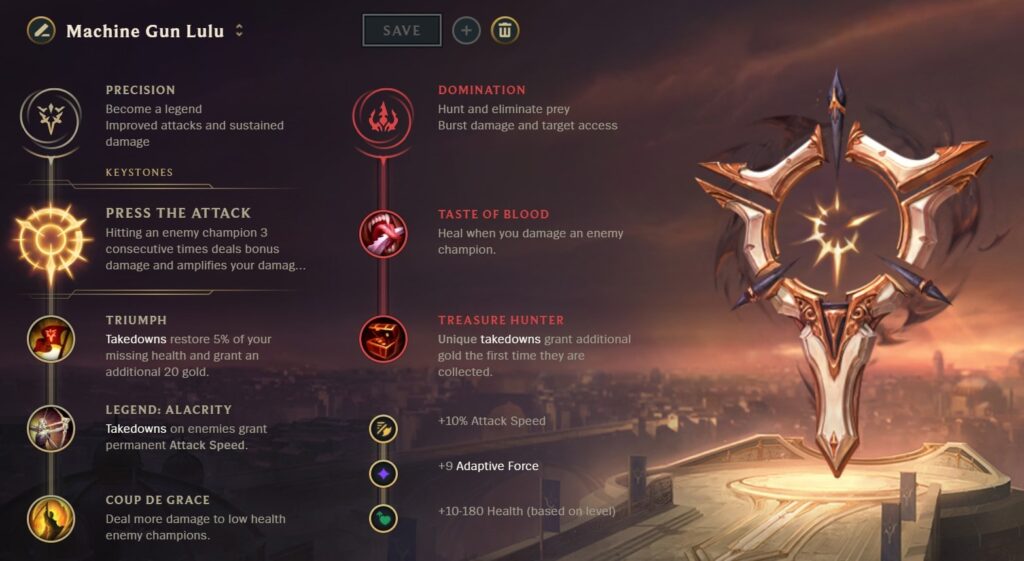
Here’s a step-by-step breakdown on how to build rune pages in LoL and find the perfect rune setup for any role.
Step 1: Create a rune page
Starting at the main screen, navigate to the “runes” section of your account’s collection and click on “Create New”. You can also create a new rune page through the champion selection menu when in the draft.
All players will get three free rune pages. If you need more, you can purchase them for 590 RP (Riot Points) or 6,300 Blue Essence. Players can simultaneously have a maximum of 25 custom rune pages, separate from the preset default rune pages available.
Step 2: Choose your primary rune path
A primary rune path should match a champion’s core playstyle. Think about what runes will enhance your chosen champion most:
- Are they a burst heavy assassin? Choose Dominion.
- Are they tanking damage on the frontline? Choose Resolve.
- Are they a DPS-heavy ADC? Choose Precision.
- Are they poke-heavy? Choose Sorcery.
- Do you want to improve utility and sustain? Choose Inspiration.
Step 3: Pick a keystone rune
Each rune path offers three unique keystones. This is your most important rune and usually defines your early and mid-game power spikes outside of items. For example, in Sorcery there is:
- Arcane Comet for extra scaling poke damage
- Summon Aery for poke damage or shielding allies
- Phase Rush for bonus movement speed for chain attacks
Choose the rune that best matches your intended playstyle.
Step 4: Select minor runes
Now, pick a secondary path that complements your primary one. This lets you select three additional runes from that primary path. These can offer extra buffs and stats, ranging from ability haste, attack speed, healing, or armour penetration.
Step 5: Choose a secondary rune path
The next step is to choose a secondary path that complements your primary one. This lets you select two more minor runes from a different path. For example, many support players pair Sorcery with Inspiration for extra sustain and utility.
Step 6: Choose stat shards
These are your final rune choices, giving your flat stat bonuses:
- One offensive slot (extra AD/AP, Attack Speed, or Ability Haste)
- One flex slot (AD/AP, Movement Speed, bonus Health)
- One defensive slot (bonus Health or Tenacity and Slow Resist)
Step 7: Save your rune page
Once happy with your choices, you should save your rune page, ready to use in ranked or draft. Now, you’re ready to play.
Rune stats explained
As with any MOBA, League of Legends is complex, filled with different champion stats. Below is a glossary of the most commonly used terms seen when navigating through LoL rune pages.
- Ability Power (AP): Increases the damage of magic-based abilities and heals/shields that scale with more AP.
- Attack Damage (AD): Boosts the power of basic attacks and physical abilities that scale with AD.
- Ability Haste: Reduces the cooldown of your abilities. The more Ability Haste you have, the more often you can use spells.
- Armor: Reduces incoming physical damage from basic attacks and AD abilities.
- Armor Penetration: Lets your physical damage ignore a portion of the enemy’s armour, making your attacks more effective against tankier opponents.
- Attack Speed: Increases how fast your champion can auto-attack.
- Critical Strike Chance: Increases the chance your attacks will deal bonus damage. Critical hits deal 200% damage by default.
- Health/Bonus Health: Increases your overall tankiness and survivability
- Heal and Shield Power: Boosts the strength of healing and shielding effects used on yourself and allies.
- Mana Regeneration: Improves resource sustain, helping you cast more abilities before running out.
- Magic Penetration: Helps your abilities ignore some of your enemy’s magic resistance.
- Magic Resistance: Reduces magic, or AP, damage taken.
- Movement Speed: Helps your champion move around the map or chase enemies quicker.
- Lifesteal: Heals you for a percentage of the damage you deal with auto-attacks.
- Tenacity: Reduces the duration of crowd control (CC) effects like stuns, slows, roots, etc.
- Omnivamp: Heals you for a percentage of all damage you deal (including abilities).
Beginner tips for LoL runes

Now you know how to set up a rune page, here are six beginner-friendly tips to choose the best runes.
Start with preset rune pages
Those new to League of Legends shouldn’t worry about customising their rune pages right away. The preset default rune pages provided by Riot are great for when you’re trying to get familiar with the game. They aren’t fully optimised, but as a beginner, they’ll function well enough.
Practice makes perfect
With everything that League of Legends demands players learn, Runes can feel overwhelming at the start, but the more experience you get, the more you’ll understand about Runes and what setups work best for your champion picks and playstyles.
Pick your main and experiment with different rune pages in Draft Pick or SwiftPlay, like changing out Electrocure for Dark Harvest when playing Ahri. In a match, marginal gains can be the difference between victory and defeat.
Match rune paths to your role & lane
Different roles and lanes have different priorities, so it makes sense that different runes work for different folks.
- Precision works best for ADCs
- Domination fits with assassins in Jungle or Mid
- Resolve for tanks or supports
Think about your lane’s win condition and tailor your runes to support that goal, and don’t go completely left-field like Precision Yuumi.
Pay attention to patch notes
Every two weeks, there are new League of Legends patch notes, buffing and nerfing everything from champions, items, and even runes. Make sure to give these a read to see how runes change, ensuring that you always have the best options on your Rune Page.
Use third-party tools
There are sites like OP.GG that’ll show you the most popular setup and LoL runes guides for your champion, updated consistently with each patch. These are a great way of learning the current meta while figuring out your own preferences and what works/doesn’t work for you.
Don’t just copy runes blindly
While it can be tempting to copy whatever runes your favourite pro uses, context, like what their lane match-up was, is vital. What works for them in pro play or high-elo likely won’t work in your ranked games. Use their pages as a reference, but don’t blindly copy them. Look at your own experience and adapt based on your match-up. The more you play, the more you will understand how runes can be used to counter your opponent and enhance your champion.
Conclusion: Mastering LoL runes
While League’s Runes can be overwhelming, once you’ve got a hang of this LoL rune guide for beginners, it will start to become muscle memory. Runes are a vital part of a League player’s arsenal, along with their champion’s kit and item builds, so knowing how they work is half the battle.
Learning the right rune setup for a specific situation requires experience. Playing consistently, practising often, and taking advantage of online tools will help build this experience. The ranked grind to Challenger starts with your keystone and rune path, so make it count.
FAQs
What are runes in League of Legends?
Runes are basically customizable passive bonuses you can choose before each match to boost your champion’s stats, damage, or utility. They help you tailor your playstyle right from the loading screen.
How to change runes in LoL?
You can edit your rune page in champ select by clicking the rune icon next to your summoner spells. Just make sure to lock in your changes before the timer runs out.
How to get more rune pages in League of Legends?
All players start with three rune pages by default, but you can buy up to 25 custom pages from the in-game store using RP or Blue Essence.
How do runes work in League of Legends?
Runes activate passively throughout the match based on the path, keystones, and shards you select. For example, if you choose Resolve with Guardian, Font of Life, Bone Plating, and Unflinching, you’re opting for a tankier build with more survivability and scaling.
REFERENCES
- Rune (Wiki League of Legends)
- Champion Statistic (League of Legends fandom)
- Home page (OP.GG)
- Home page (U.GG)