TL;DR
- There are eight Rainbow Six ranks, which are comprised of 36 levels. Champion has no subdivisions; the other seven ranks each have five divisions (V to I).
- While there’s no rank decay, R6 ranks do reset with each new season. However, Diamond and Champion ranks can see penalties for prolonged inactivity.
- The best Rainbow Six Siege rank is Champion, accounting for 0.2% of players.
- After a reset, everyone starts back on Copper V, the lowest Rainbow Six Siege rank.
- Ubisoft changed the game’s competitive scene with Ranked 2.0 in December 2022.
- Matchmaking is no longer determined solely by visible rank, but by a combination of Rank Points (RP) and hidden Skill (formerly MMR).
Rainbow Six Siege has become a stalwart in the tactical FPS genre, with Ubisoft keeping players in the loop for over 10 years. Competitive matches are often what keep players hooked in FPS titles, and if players want to climb the ranks in Rainbow Six Siege, they need to know about it.
Ranked play is already a challenging experience in FPS games, but it also makes the genre incredibly fun to watch. With its tactical edge, R6 Siege’s ranking system can be complicated to understand, but we’ve got you covered, going over more than just the ranks. We’ll outline what each division means, how they’re calculated, how they differ from the old MMR-based system, and how you can better climb the ranks.
While there’s a lot to cover, this guide should have everything you need to know about Rainbow Six Siege ranks.
Rainbow Six Siege ranks & divisions
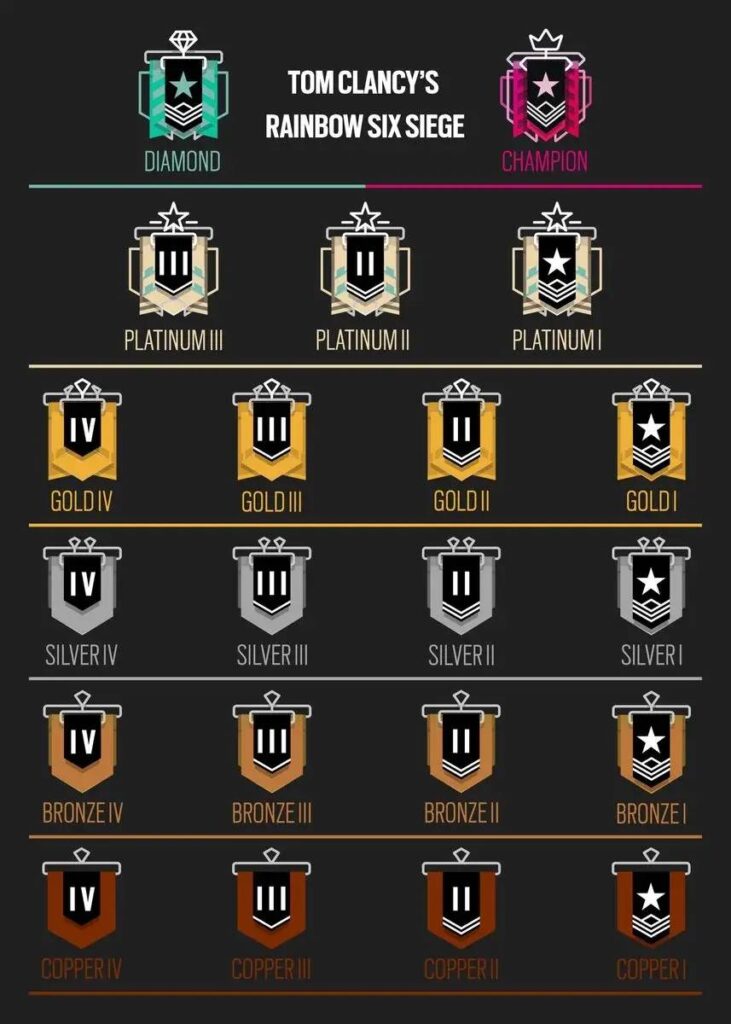
So, what are the ranks in Rainbow Six Siege?
There are eight Rainbow Six Siege ranks in the competitive meta, and they are as follows: Copper, Bronze, Silver, Gold, Platinum, Emerald, Diamond, and Champion. Except for Champion, all divisions have five tiers each, denoted with Roman numerals (V to I), with V as the lowest and I being the highest. Oddly, this is the opposite of most other shooters, where “I” or 1 tends to be the lowest rank.
There used to be a hidden MMR (matchmaking rating) behind all ranks in Siege to determine who should play who, but this system was later changed out.
Ubisoft announced with Ranked 2.0 that MMR would no longer define who you’ll play against when the Emerald rank was introduced. Instead, your rank will now be determined by RP (ranked points). Below, we’ve included the full R6 rank list (and their rough MMR equivalent).
All Rainbow Six Siege ranks in order
| Rank | Divisions | MMR range |
|---|---|---|
| Copper | V, IV, III, II, I | 0 – 1,600 |
| Bronze | V, IV, III, II, I | 1,600 – 2,099 |
| Silver | V, IV, III, II, I | 2,100 – 2,599 |
| Gold | V, IV, III, II, I | 2,600 – 3,100 |
| Platinum | V, IV, III, II, I | 3,200 – 4,099 |
| Emerald | V, IV, III, II, I | Added in Ranked 2.0 |
| Diamond | V, IV, III, II, I | 4,100 – 4,999 |
| Champion | No divisions | 5,000+ |
How the Rainbow Six Siege ranking system works
In December 2022, the Rainbow Six Siege ranking system was changed. The Emerald Rank was added between Platinum and Diamond, while Ubisoft also replaced the original MMR system with Skill and Rank metrics.
“Skill” has become a straight replacement for MMR, representing the ability you bring to win a game, how well you work with your team, and how well your operators do against rivals. From these metrics, a rough estimation is determined.
Note that this is a rough system for determining Rainbow Six Siege ranks, since there are many variables at play. Ubisoft itself has complained that the system can be “probabilistic.”
By playing more games, your Skill rank will be more accurately updated based on the outcome of matches, which can be swayed by consistent (or abnormal) performance.
Every rank in R6 demonstrates your progression up the competitive ladder, something which has remained consistent throughout the game’s launch in December 2015; only now, there are eight divisions instead of seven.
The player base responded to the changes with mixed feelings, with some stating that the matchmaking became more unreliable and the linear progression system felt more drawn out with five more levels of the Emerald rank. However, many players appreciated seeing their progress with greater fairness and visibility.
There have even been situations of Copper V, the lowest rank, being matched up to Champions, the best rank in Siege, which shows that the new system isn’t always perfect. With a shift away from the hidden MMR system to a more transparent one, there were bound to be moments where things were inconsistent.
Rainbow Six Siege rank distribution
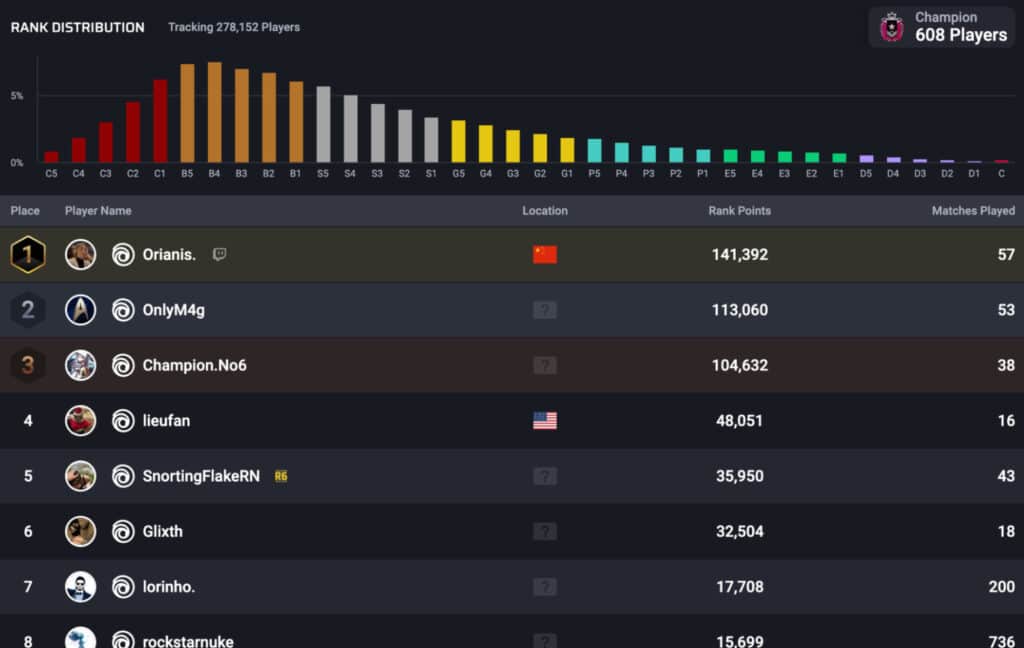
Rainbow Six Siege rank distribution follows a similar trajectory to what we’ve seen from Dota 2 ranks and VALORANT ranks, in that there’s something of a pyramid shape when analysing the user base from the lowest to the highest ranks.
According to data from the Rainbow Six Siege Tracker for Year 10 Season 4: Operation Tenfold Pursuit, there are over 522,000 players across the game’s competitive scene. This is as of January 2026.
The most populated R6 Siege ranks are Bronze V and Bronze IV, with both having over 6% of the player base (roughly 32,000 players). This is followed by Bronze III, where just under 6% (roughly 30,000 players) play.
After Bronze IV, there’s a steady drop curve into the higher ranks, with each Silver subrank having 3 – 5% of players, and each Gold subrank having 2 – 3.5%. When you get to the best Rainbow Six Siege ranks, the player numbers only get slimmer, with all but one (Platinum V) Platinum and Emerald subrank being under 2%.
It shouldn’t come as a shock, then, to see Diamond be diluted even further, with each subrank being under 1.1% each.
Champion does not have a level or tier system, so this elite rank only accounts for 0.4% of players, with a confirmed number of roughly 2,500 players right now.
How to climb Rainbow Six Siege ranks
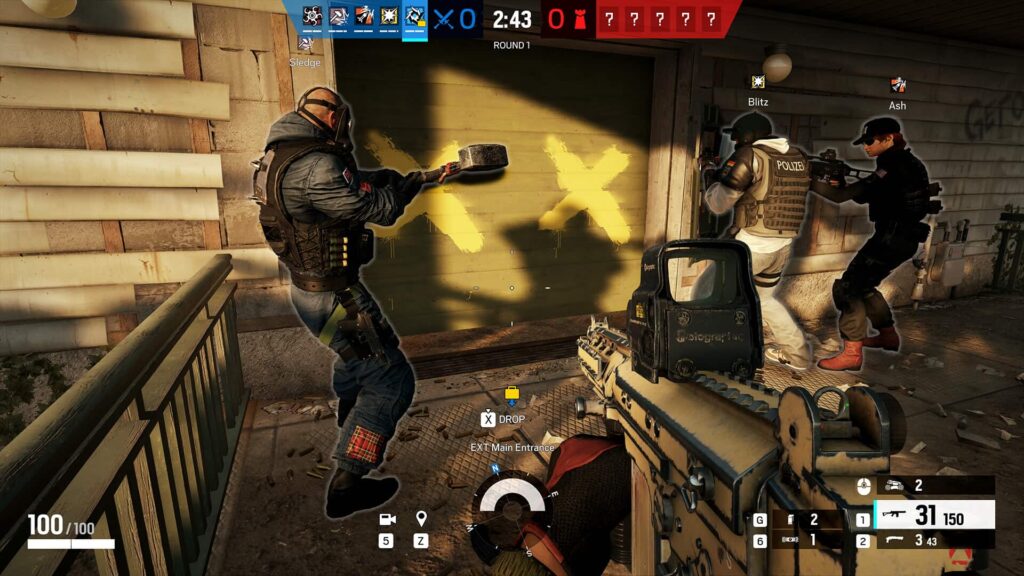
As with every competitive, PvP game, there is no instant fix solution to shooting up the ranks in Rainbow Six Siege. FPS titles typically have rough difficulty curves, and with the tactical elements of R6 Siege, it makes this difficulty curve even steeper. With the emphasis on steady, controlled, close-quarters gunplay and instant decision-making, climbing the ranks requires persistent and consistent improvement.
Becoming better at Rainbow Six Siege is famed for its difficulty, but the best place to start is improving the fundamentals. Only Level 50 and above players can play Ranked Siege, so this learning period is the perfect time to develop the basics, like handling how to breach, controlling your firearms, learning strategies, and getting a handle on an Operator’s kit.
So this is more about smoothing out the inconsistencies of your play, learning from your mistakes, and thinking as tactically as possible instead of just being the best shot on the team.
Pro tip: Adjusting your aim sensitivity and experimenting with how each weapon feels with different mouse DPI settings can be a big help.
For some weapons, you’re going to want more of a drag with lower sensitivity if you have to be particularly precise, whereas a weapon with a longer range (or further spread) can be used with a higher mouse DPI, such as the Reaper Mk 2, SMG-11, or the SC3000K. It also means becoming more familiar with what some of the best Rainbow Six Siege operators, such as Blackbeard, Maverick, Ace, Ash, Thermite, and Brava, can do.
The Rainbow Six Siege operators are split into two categories: Attackers and Defenders. As their names imply, Attackers are better on the offensive, and Defenders are suited to defending.
A huge part of becoming a better Siege player is to understand the objectives and your role within a team. It’s not just about scoring a high K/D ratio or trying to do a team wipe. Instead, high-ranked play is about the mental side as well as the physical side.
You’ll earn Siege rank points for winning ranked matches, but how many players you eliminate is also taken into consideration. Remember, your Skill rating is not based on your K/D ratio, but rather on how many matches you have won. That means going up R6 ranked levels can be done by playing objectives, effectively communicating with your teammates, and trying to survive, instead of charging in headfirst. Also, queue with a reliable squad whenever possible, since it leads to extra RP gains because of less variance in teammate performance.
As there are no restrictions on which ranks can play together, this could be harder if you’re a lower rank (such as Bronze or Silver) being matched up with Gold, for example.
Ever since the Ranked 2.0 changes, the system evaluates early-season games more heavily, so getting those early wins in will help you get to the right rank faster.
Finally, a great way to provide your performances with more consistency and climb the Rainbow Six Siege ranks is to learn the map layouts like the back of your hand. This isn’t as rough as it sounds, as only 16 of the 36 available maps are in the ranked pool. You’ll find yourself quickly outmatched if you don’t know where the chokepoints and effective entryways on certain maps are.
Instead of trying to do this in regular games, you can go through the Practice Mode (Training Grounds) to do walkarounds of each area (with any operator) at your own pace. There are even detailed YouTube guides on exactly where to go and what to look for, which you should familiarise yourself with before you jump into a ranked game.
Rainbow Six Siege rank decay
There is no rank decay in Rainbow Six Siege to worry about, meaning that you’ll retain your rank even if you don’t consistently play or try and move up the ladder competitively.
With that said, Rainbow Six Siege ranks reset as each new season is introduced (which generally happens every three months or so). The visible rank resets to Copper V, and you’ll have to climb your way back up, effectively making ranks completely seasonal.
With Ranked 2.0, they became more of a visual emblem rather than a denotation of your abilities, as Skill replaced the previously hidden MMR system for skill-based matchmaking.
However, Skill (hidden rating) can lose effectiveness if you’re completely inactive, which might mean you drop more RP when you return due to skill/rank disparity. So it’s best to stay active and consistent.
Conclusion
The Rainbow Six Siege ranking system might seem complicated at first, but it can be better understood now thanks to our thorough guide. Across the eight divisions (and 36 levels), they act as a rough indicator of how well you play, but are not necessarily indicative of performance.
That’s because there are no restrictions on who can play together, as Skill now determines who you play against instead of the previously hidden MMR. It’s still worth climbing the ranking ladder in 2026, even if the reformed system with Ranked 2.0 isn’t (generally) as favourably viewed as in previous years.
For those wanting to know more about the competitive Rainbow Six Siege esports scene, check out our R6 content. We go into the team playing professionally, what tournaments are happening, who are the biggest players in the scene, and how the meta evolves.
R6 is known for being team-driven, which is why the climb up its ranks can often feel so different to other FPS games, like CS2 or VALORANT. Aim alone isn’t enough. Communication, patience, and knowledge, particularly with maps, are just as vital.
FAQs
What is the lowest rank in Rainbow Six Siege?
The lowest Rainbow Six Siege rank is Copper V, which is where all players end up after a soft reset.
What is the highest rank in Rainbow Six Siege?
The highest Rainbow Six Siege rank is Champion, which accounts for only 0.2% of players currently.
How many games does it take to rank up in R6?
There’s no set amount of matches needed to rank up in Rainbow Six Siege. However, 100 Rank Points is (usually) enough to move up to the next level, depending on the division, which accounts for roughly three consistent wins. Early-season matches tend to influence rank movement more strongly (due to larger RP swings), which means gaining wins early helps significantly.
What is the average Siege rank?
The average Siege rank based on population is Bronze V and Bronze IV, which accounts for a little over 6% of players (32,000) each.
Can lower ranks play with higher ranks in Ranked?
Yes. Ubisoft does not prevent mixed-rank groups from queuing together, but matchmaking will use hidden Skill to try to balance games to the highest possible degree.