TL;DR
- Sports betting is the act of placing a wager on the outcome of a sporting event. By predicting the correct result, you win money based on the odds and your stake.
- Different types of sports betting include moneyline, point spread, and over/under bets.
- Football, including both soccer and the NFL, basketball, and horse racing, are consistently among the most popular sports to bet on.
- The legality of sports betting differs around the world. Many nations in Europe choose to regulate the industry, whereas some states in the U.S. prohibit it.
In this guide, we’ll break down everything you need to know about sports betting — from its distinctive origins to the step-by-step process itself, the most popular sports to bet on, and all relevant legalization matters.
So, whether you’re a total beginner or you want to simply dive in deeper, this is the beginner’s ultimate sports betting information manual.
What is sports betting?
Sports betting is the act of placing a wager on the outcome of a sporting event. Such outcomes include: who will win a match, how many points will be scored, or which player will perform best. If your prediction is correct, you win money. If not, you lose your stake.
There are many sports and betting options to choose from, including football, basketball, tennis, horse racing, and more. You can bet on full-time results, in-play moments, or specific player and team statistics, depending on the sportsbook. Each bet comes with odds, which determine how much you can win.
Just as important as understanding the bets is where you place them. The golden rule is to choose a licensed and regulated sportsbook. This ensures fair odds, secure payments, and proper protection for your funds throughout your sports betting experience.
Sports betting rules
Sports betting rules are the fundamental guidelines that outline how bets are placed and how winnings are distributed. These rules cover things like minimum and maximum bets, settlement rules, voided bets, how odds are calculated, what bets are calculated at full-time or after extra time/penalties, and many more.
Every sportsbook has its own house rules, so it’s essential to read them before placing a bet. A good knowledge of these rules helps you avoid painful surprises and know precisely what to expect when betting.
Sports betting vs gambling
Sports betting is categorized as a type of gambling, but not all gambling is sports betting. Sports betting focuses specifically on predicting the outcome of sporting events, such as football matches, basketball games, horse racing, or tennis tournaments. You place a bet based on your knowledge, analysis, or opinion of something happening in reality.
Gambling is a broader term that encompasses games of pure chance, such as slot machines, roulette, or lottery games. In these games, the outcomes are random, and skill doesn’t determine if you win or not. In fact, it plays little to no role.
In essence, sports betting often involves research, knowledge of the game, and decision-making. On the other hand, gambling activities rely mostly on luck.
How to bet on sports
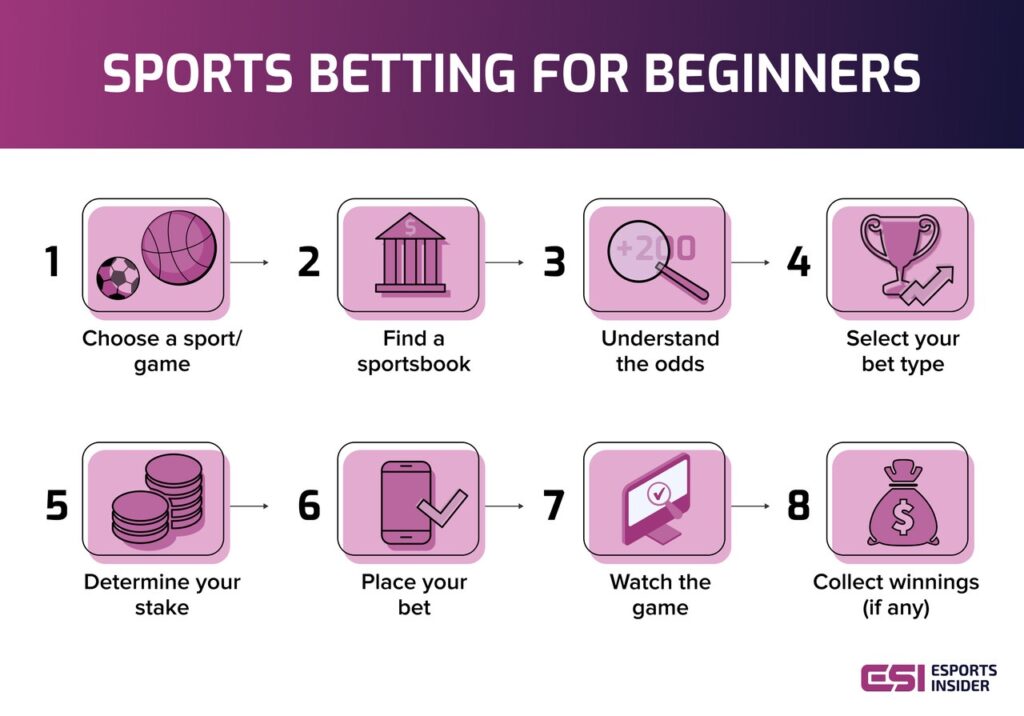
Sports betting is easier to understand when you break it down into simple steps. Here’s how the process works from start to finish:
- Select a sport and game: Start by choosing the event you want to bet on. This could be a football match, a basketball game, a tennis tournament, or even an esports competition.
- Find a sportsbook: Pick a licensed sportsbook, either a physical betting shop or an online betting site. The sportsbook lists all available events along with their odds.
- Understand the odds: Look at the odds for each possible outcome. This helps you determine how much to stake and shows you the potential winnings if your prediction is correct.
- Select your bet type: Select the type of bet you’d like to place.
- Determine your stake: Decide how much you’d like to place on the bet. Ensure it’s not more than you can afford to lose.
- Place your bet: Enter the amount you want to wager, and confirm your bet.
- Watch the outcome: Once the event ends, the result decides whether your bet wins or loses. If you win, your payout is added to your account.
- Collect your winnings: Withdraw your money from the sportsbook account into your personal account.
The evolution of sports betting: A brief history
Sports betting has been around for thousands of years. The earliest known wagers were placed on athletic contests and gladiator fights in ancient Greece and Rome, where spectators bet on outcomes purely for excitement and pride. Over time, betting followed sports wherever they went, slowly becoming more organized and structured.
The modern sports betting world began to take shape in the late 20th century. Traditional trackside bookmakers and betting shops became popular, especially for horse racing and major sporting events. Then came the internet in the late 1990s, which completely changed the game.
Online sportsbooks made it possible to place bets from home, opening sports betting to a much wider audience. The most significant recent shift has been mobile betting. Smartphones and mobile betting apps now allow players to place bets instantly, even during live games.
This convenience has driven massive growth. Today, betting odds are often even shown during live sports broadcasts. With sports betting revenue projected to reach $17.23 billion in 2025, the industry shows no signs of slowing down.
History of sports betting in America
The history of sports betting in America is one long and dramatic journey. For many years, legal sports betting was almost entirely limited to Nevada, with Las Vegas acting as the country’s betting capital. In most other states, sports betting was either banned or pushed underground.
This all changed in 2018, when the U.S. Supreme Court struck down a federal law called PASPA (the Professional and Amateur Sports Protection Act). PASPA had prohibited states from allowing betting on professional and amateur sports, with Nevada being the exception.
Once PASPA was overturned, individual states were free to create their own sports betting laws. Since then, many states have launched regulated sports betting platforms, both online and in-person.
As a result, sports betting has quickly become one of the fastest-growing forms of entertainment in the United States, with millions of Americans now able to bet legally and safely from home.
How sports betting works
There is nothing complicated or confusing in how sports betting works, but you do need to master the basics before jumping in. Here are some pointers to hold onto:
- The odds are the lifeblood of sports betting. They display the likelihood of an event happening.
- The bookmaker sets the odds based on the probability of that event occurring. Those odds determine how much you can win.
- The sportsbook also builds in the vigorish, also known as the odds margin, a commission or percentage they take for placing your bet.
- Once the odds are in place, you wager on any market of your choice. A bet on a favorite team or player will have a lower payout compared to wagering on an underdog.
- If your bet wins, you’ll be paid out according to your stake and the odds on which the bet was placed.
EXAMPLE: There’s a match between Team A and Team B. Let’s say you decide to place a $10 wager on Team A to win over Team B at odds of +200. If you win, you’ll receive $20 in addition to your $10 bet. This brings the final payout to $30 in this case
Note that betting odds can change regularly due to various conditions, such as injury news, form, the number of bets on the same market, weather conditions, and other factors.
American odds basics (Plus/minus explained)
There are different types of odds formats, and their use is mostly determined by geographical location. In Europe, decimal odds are common, while moneyline odds, also known as American or plus/minus odds, are more prevalent in the United States.
The American odds use a plus (+) and minus (−) system.
- Minus odds (e.g., −150) designate the favorite and show how much you need to bet to win $100.
- Plus odds (e.g., +200) designate the underdog and show how much you win from a $100 bet.
The plus and minus odds system is very common in the US. You need to get a good understanding of it to avoid staking on wrong odds.
Sports betting terms explained
Sports betting has a vast array of terminology and phrases used to describe various actions or events. Here are some of the most important ones to understand and memorize:
| Term | Meaning |
|---|---|
| Odds | The numbers showing the probability of a win and the potential payout |
| Stake | The amount of money you bet |
| Favorite | The expected winner of a match or event, with lower odds |
| Underdog | The less likely winner of a match or event, with higher odds |
| Payout | A prize (money) you receive if your bet wins |
| Sportsbook | The platform or bookmaker taking the bet |
What types of sports betting are there?
While there are several different variations of bets, often with alternative names and terminologies, in principle, the most popular types of sports bets that are available are as follows:
Moneyline sports bets
Moneyline bets are one of the simplest bets to place with your chosen sportsbook. You’ll be betting on which team or player you think will win the game. If you predict correctly, then your bet will be settled as a win.
Point spread bets
In a point spread bet, you’ll be betting on a team to cover a points advantage, or for a team to make up a points deficit. This type of betting market is popular in games that are predicted to be one-sided, where there isn’t much value in the moneyline market.
Over/under (totals) bets
Over and under totals bets factor in markets that can include the total number of goals scored in a Premier League match or the combined teams’ score at the end of an NFL game. Here, sportsbooks will provide odds as to whether a total score will be more or less than the figure given.
Parlays
Parlay bets are often called accumulator bets, and they allow you to combine a series of different bets into one. These can be trickier bets to perfect as you need every bet to come in to win; however, if they do, your winning payout will be far greater.
Prop bets (proposition bets)
Prop bets give you the chance to bet on an individual athlete’s performance. This can involve betting on the first home run scorer in the World Series or which player will concede the most fouls in the NHL Stanley Cup Final.
Future bets
Futures bets are also known as outright bets. Here, you’ll be betting on long-term betting markets, whereas most other bets are gameday-type bets. These are longer-term wagers that can be placed on events that may take weeks or even months to conclude, such as which team will win the league or which player will win MVP at the end of the season.
Popular sports to bet on
As you can imagine, sporting contests are primed with betting opportunities. Not only does each sport boast a wealth of available statistics and historic head-to-head matchups, but it also sees rival fan bases wagering on the belief that their teams will win.
Bookmakers worldwide can offer an almost unlimited number of sports betting markets across almost every sport imaginable. The most popular of these tend to focus on major events such as the Super Bowl, UEFA Champions League, or the World Cup.
To illustrate this, here is a shortlist of just some of the most popular sports that people enjoy betting on:
⚽ Soccer (football)
Due to its global appeal, almost every nation has a domestic league format of its own. Bettors can enjoy year-round action, making this game the world’s most-bet-on sport. Popular leagues such as the Premier League, Ligue 1, Bundesliga, and LaLiga are some of the most eye-catching leagues to wager funds on, with plenty of depth covered within their betting markets.
🏈 American football (NFL)
Ideal for point spread betting, parlays, and individual player prop bets, running from late summer to the Super Bowl in early February, the NFL is incredibly popular, with billions being wagered every season.
🏀 Basketball (NBA & NCAA)
The sheer volume of games and frequently high-scoring matchups make basketball a favourite among sports bettors, particularly those who prefer over/under market and in-play betting during the NBA finals and March Madness competitions.
🐎 Horse racing
You can wager on horse racing events across the globe on a daily basis. With high-profile events such as the Kentucky Derby, Cheltenham Festival, Grand National, and Royal Ascot, there’s plenty to look forward to.
🎾 Tennis
There are many different tennis tournaments taking place regularly, so you’ll be spoilt for choice on that front! This includes Grand Slam events such as the U.S. Open, Wimbledon, Australian Open, and French Open.
🎯 Darts
The popularity of darts has grown significantly in recent years, with the rise of Luke Littler being a key factor behind its growth. The young Brit has rivaled the likes of Luke Humphries, Gerwyn Price, and Michael van Gerwen for the biggest titles in darts. There are plenty of different darts betting markets available across sportsbooks, so you’ll have the ultimate darts betting experience at your fingertips.
If you are interested in sports betting, keep in mind that gambling carries financial risk and can lead to addiction. We recommend that everyone gamble responsibly, play within their limits, and never bet more than they can afford to lose.
Sports betting legality & regulation
As you might expect, the legal status of sports betting varies, often purely based on where a bettor is placing their sports-oriented wagers.
While some nations, such as the UK, parts of Europe, and Australia, fully embrace legal sports betting, in other countries and regions, sports betting can be prohibited or enforced with strict legislative restrictions.
| Europe | In-person sports betting | Online sports betting | Regulatory body |
|---|---|---|---|
| Denmark | ✅ | ✅ | Danish Gambling Authority (Spillemyndigheden) |
| France | ✅ | ✅ | National Gaming Authority (ANJ) |
| Germany | ✅ | ✅ | Joint Gambling Authority (GGL) |
| Netherlands | ✅ | ✅ | Kansspelautoriteit (KSA) |
| Ireland | ✅ | ✅ | Gambling Regulatory Authority of Ireland (GRAI) |
| Italy | ✅ | ✅ | Agenzia delle Dogane e dei Monopoli (ADM) |
| Spain | ✅ | ✅ | Directorate General for the Regulation of Gambling (DGOJ) |
| Sweden | ✅ | ✅ | Swedish Gambling Authority (Spelinspektionen) |
| UK | ✅ | ✅ | UK Gambling Commission (UKGC) |
Sports betting legalization in the United States
As mentioned earlier, the turning point for U.S. sports betting came in May 2018, when the U.S. Supreme Court struck down the nationwide federal ban on betting on sports.
Since that date, dozens of states have begun to roll out regulated sports betting measures, each with its own set of rules and sportsbook platforms.
| US State / Territory | In-person sports betting | Online sports betting | Regulatory body |
|---|---|---|---|
| Alabama | ❌ | ❌ | No regulatory body |
| Alaska | ❌ | ❌ | No regulatory body |
| Arizona | ✅ | ✅ | Arizona Department of Gaming |
| Arkansas | ✅ | ✅ | Arkansas Racing Commission |
| California | ❌ | ❌ | No regulatory body |
| Colorado | ✅ | ✅ | Colorado Division of Gaming |
| Connecticut | ✅ | ✅ | Department of Consumer Protection – Gaming Division |
| Delaware | ✅ | ✅ | Delaware Lottery |
| Florida | ✅ | ✅ | Florida Gaming Control Commission |
| Georgia | ❌ | ❌ | No regulatory body |
| Hawaii | ❌ | ❌ | No regulatory body |
| Idaho | ❌ | ❌ | No regulatory body |
| Illinois | ✅ | ✅ | Illinois Gaming Board |
| Indiana | ✅ | ✅ | Indiana Gaming Commission |
| Iowa | ✅ | ✅ | Iowa Racing and Gaming Commission |
| Kansas | ✅ | ✅ | Kansas Racing and Gaming Commission |
| Kentucky | ✅ | ✅ | Kentucky Horse Racing Commission |
| Louisiana | ✅ | ✅ | Louisiana Gaming Control Board |
| Maine | ✅ | ✅ | Maine Gambling Control Board |
| Maryland | ✅ | ✅ | Maryland Lottery and Gaming Control Agency |
| Massachusetts | ✅ | ✅ | Massachusetts Gaming Commission |
| Michigan | ✅ | ✅ | Michigan Gaming Control Board |
| Minnesota | ❌ | ❌ | No regulatory body |
| Mississippi | ✅ | ❌ | Mississippi Gaming Commission |
| Missouri | ✅ | ✅ | Missouri Gaming Commission |
| Montana | ✅ | ❌ | Department of Justice – Gambling Control Division |
| Nebraska | ✅ | ❌ | Nebraska Racing and Gaming Commission |
| Nevada | ✅ | ✅ | Nevada Gaming Control Board and Nevada Gaming Commission |
| New Hampshire | ✅ | ✅ | New Hampshire Lottery Commission |
| New Jersey | ✅ | ✅ | New Jersey Division of Gaming Enforcement and Casino Control Commission |
| New Mexico | ✅ | ❌ | New Mexico Gaming Control Board |
| New York | ✅ | ✅ | New York State Gaming Commission |
| North Carolina | ✅ | ✅ | North Carolina State Lottery Commission |
| North Dakota | ✅ | ❌ | Gaming Division of the North Dakota Attorney General’s Office |
| Ohio | ✅ | ✅ | Ohio Casino Control Commission |
| Oklahoma | ❌ | ❌ | No regulatory body |
| Oregon | ✅ | ✅ | Oregon Lottery |
| Pennsylvania | ✅ | ✅ | Pennsylvania Gaming Control Board |
| Rhode Island | ✅ | ✅ | Rhode Island Lottery |
| South Carolina | ❌ | ❌ | No regulatory body |
| South Dakota | ✅ | ❌ | South Dakota Commission on Gaming |
| Tennessee | ❌ | ✅ | Tennessee Sports Wagering Advisory Council |
| Texas | ❌ | ❌ | No regulatory body |
| Utah | ❌ | ❌ | No regulatory body |
| Vermont | ❌ | ✅ | Vermont Department of Liquor and Lottery |
| Virginia | ✅ | ✅ | Virginia Lottery |
| Washington | ✅ | ✅ | Washington State Gambling Commission |
| West Virginia | ✅ | ✅ | West Virginia Lottery Commission |
| Wisconsin | ✅ | ✅ | Wisconsin Department of Administration – Office of Indian Gaming |
| Wyoming | ❌ | ✅ | Wyoming Gaming Commission |
State-approved licensed operators must monitor and comply with any changes to the law.
These include account holder identity checks, responsible gambling measures and safeguards, transactional security checks, and money laundering checks. These measures are necessary in an industry susceptible to underage betting, corruption, and unlawful advertising.
Conclusion
Sports betting can be equally as profitable as it is exciting. If you prefer to place bets at a land-based bookmaker or at an online sportsbook, having adequate knowledge of how sports betting works gives you the upper hand already.
While this guide has explained the basics of how sports betting works, including key aspects such as odds, terms, legislation, history, and bet types, it’s also important to recognize the importance of responsible betting.
Ensure you follow responsible gambling guidelines, such as setting limits, managing your bankroll, taking timeouts, and seeking help when needed.
FAQs
How does sports betting work?
You place a bet on a sporting outcome, such as who will win or how many points will be scored. If your prediction is correct, you win based on the odds.
What does +200 odds mean?
+200 means you win $200 for every $100 you bet if the wager is successful.
Why is sports betting illegal?
Sports betting isn’t illegal everywhere. Laws vary by country or state, often based on regulations, consumer protection, and concerns related to gambling.
What is a sports betting app?
It’s a mobile app that allows you to place sports bets, view odds, deposit funds, and cash out winnings directly from your phone.
What do the + and − mean in sports betting?
The minus (−) shows the favorite and how much you must bet to win $100. The plus (+) shows the underdog and how much you win from a $100 bet.
Can you go to jail for sports betting?
In regulated areas, no. Problems only arise if betting is illegal in your location or if you bet via unlicensed platforms.